

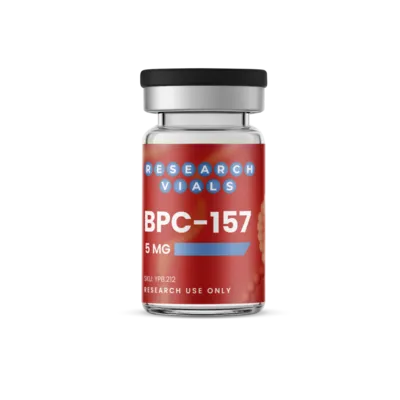
BPC-157 is the most widely purchased research peptide for tissue repair studies, with over 100 published preclinical studies investigating its cytoprotective and regenerative properties. However, not all BPC-157 products are equivalent. This buyer's guide covers everything researchers need to make an informed purchase decision: salt forms, purity grades, dosing data from published literature, reconstitution protocols, and supplier verification.
Understanding BPC-157: Quick Profile
BPC-157 (Body Protection Compound-157) is a synthetic pentadecapeptide with the sequence Gly-Glu-Pro-Pro-Pro-Gly-Lys-Pro-Ala-Asp-Asp-Ala-Gly-Leu-Val. Key characteristics:
- Molecular weight: 1,419.53 Da (free acid)
- CAS number: 137525-51-0
- Origin: Derived from human gastric juice protein BPC
- Stability: Uniquely stable in gastric juice -- unlike most peptides
- Primary mechanisms: VEGF upregulation, NO system modulation, FAK-paxillin activation, growth factor expression
- Research areas: GI protection, tendon/ligament repair, muscle healing, neuroprotection
Salt Forms: Acetate vs Free Base
BPC-157 Acetate (Most Common)
The acetate salt form is produced when BPC-157 is purified using HPLC with a TFA/acetate buffer system and then lyophilized. Key characteristics:
- Excellent water solubility
- Stable as lyophilized powder at -20C for 12+ months
- Counter-ion content means the actual peptide mass is approximately 75-85% of weighed mass
- Most commonly available and most widely used in published research
BPC-157 Arginine Salt
An alternative formulation using arginine as the counter-ion. Proponents suggest improved stability, though head-to-head stability comparison data is limited. Less commonly available from suppliers.
Which to Choose?
For most research applications, BPC-157 acetate is the standard choice. It is the form used in the majority of published studies, making it easier to compare your results with existing literature. If you're replicating a specific published protocol, match the salt form used in that study.
Purity Grades and What They Mean
BPC-157 is commercially available at several purity levels:
- 99%+ (Research Premium): Highest quality available. Suitable for all research applications including quantitative binding assays and publication-grade work. This is the purity level offered by Research Vials
- 98-99% (Research Standard): Appropriate for most preclinical research applications
- 95-98% (Research Economy): Suitable for preliminary screening studies but may contain enough impurities to affect sensitive assays
- Below 95%: Not recommended for any research application
Dosing Data from Published Literature
Published preclinical studies have used BPC-157 across a range of doses and administration routes. For researchers designing protocols, the following table summarizes the most commonly cited dosing parameters:
| Research Model | Route | Dose Range | Citation |
|---|---|---|---|
| Gastric ulcer (rat) | IP / IG | 10 mcg/kg | PMID: 10469895 |
| Tendon repair (rat) | IP / local | 10 mcg/kg | PMID: 16609970 |
| Colitis model (rat) | IP / oral | 10-50 mcg/kg | PMID: 21548867 |
| Muscle injury (rat) | IP | 10 mcg/kg | PMID: 21030672 |
| Nerve repair (rat) | IP | 10 mcg/kg | PMID: 29737246 |
The dose of 10 mcg/kg administered intraperitoneally (IP) is the most frequently used across published studies and serves as the standard reference dose for BPC-157 preclinical research.
Reconstitution Protocol
Proper reconstitution is essential for maintaining peptide activity. Follow this standard protocol:
- Solvent selection: Bacteriostatic water (BAC water, 0.9% benzyl alcohol) is recommended for research reconstitution. It provides antimicrobial preservation that extends solution stability
- Preparation: Allow the lyophilized vial to reach room temperature before opening. Direct the solvent stream against the vial wall, not directly onto the powder cake
- Volume: For a 5 mg vial, adding 2 mL of BAC water yields a concentration of 2.5 mg/mL (2,500 mcg/mL). Use the Research Vials reconstitution calculator for precise volume calculations
- Mixing: Gently swirl the vial to dissolve. Do not shake vigorously -- excessive agitation can denature peptides through shear stress and foaming
- Storage: Reconstituted BPC-157 in BAC water should be stored at 2-8C and used within 3-4 weeks
BPC-157 + TB-500 Combination
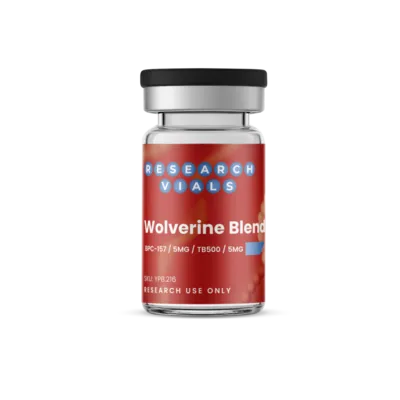
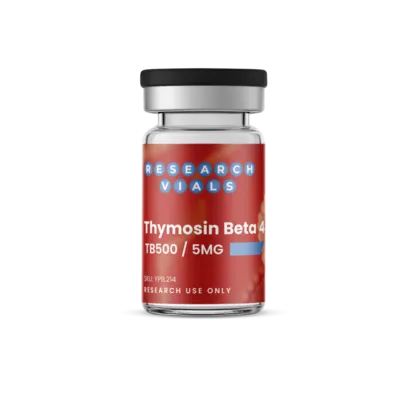
A growing body of research examines the combined use of BPC-157 with TB-500 (thymosin beta-4 fragment). The rationale is complementary mechanisms: BPC-157 promotes angiogenesis via VEGF while TB-500 enhances cell migration via actin dynamics. Research Vials offers these both individually and as the pre-formulated Wolverine Blend.
Where to Buy BPC-157
Research Vials offers BPC-157 at 99%+ purity with the following specifications:
- Third-party HPLC and mass spectrometry testing
- Batch-specific COA with chromatogram
- Available in 5mg vials at $35
- USA-based shipping with cold-chain protocols
- Free shipping on qualifying orders
Purchase BPC-157 directly at researchvials.com.
References
- Sikiric P, Seiwerth S, Rucman R, et al. Stable gastric pentadecapeptide BPC 157: novel therapy in gastrointestinal tract. Curr Pharm Des. 1999;5(8):597-611. PMID: 10469895
- Staresinic M, Petrovic I, Novinscak T, et al. Effective therapy of transected quadriceps muscle in rat: Gastric pentadecapeptide BPC 157. J Orthop Res. 2006;24(5):1109-1117. PMID: 16609970
- Chang CH, Tsai WC, Lin MS, et al. The promoting effect of pentadecapeptide BPC 157 on tendon healing. J Appl Physiol. 2011;110(3):774-780. PMID: 21030672
- Sikiric P, Rucman R, Turkovic B, et al. Novel cytoprotective mediator, stable gastric pentadecapeptide BPC 157. Curr Pharm Des. 2018;24(18):1990-2001. PMID: 29737246