
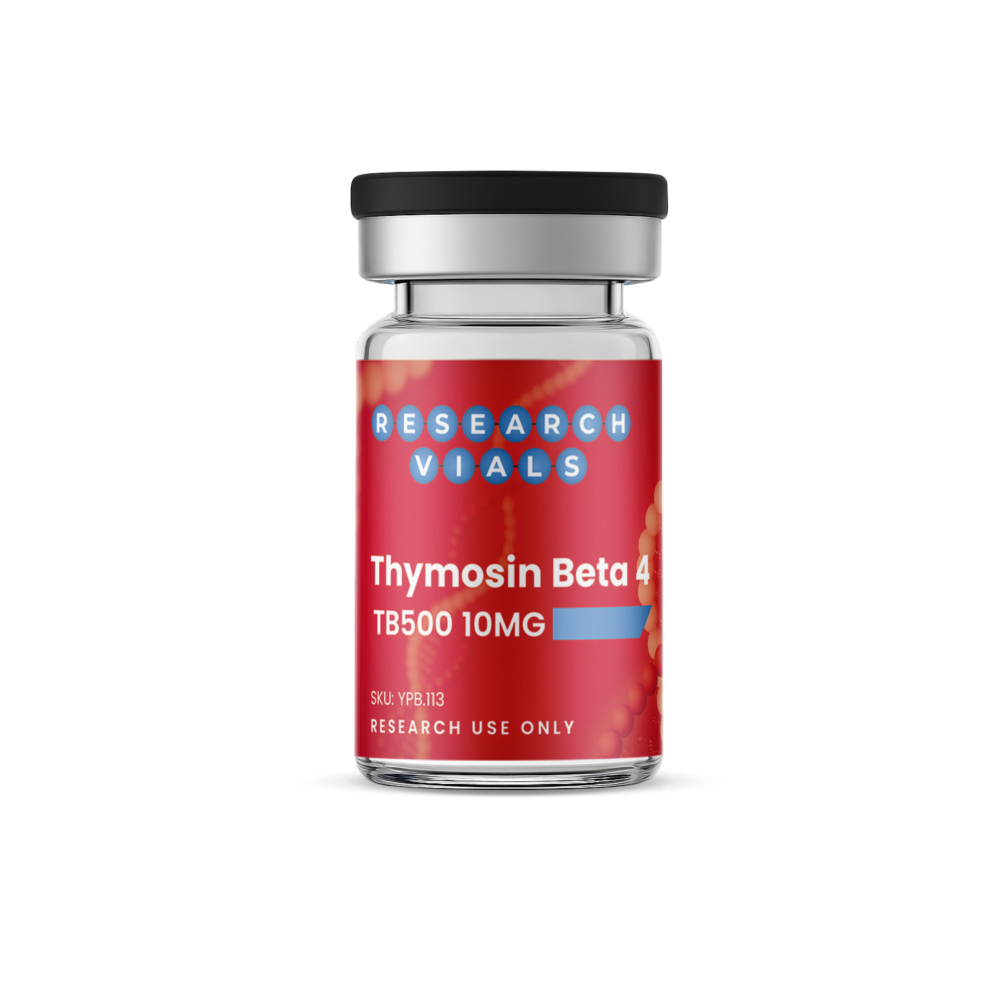
Thymosin Beta-4 (TB500) 10mg
Thymosin Beta-4 (TB-500 Fragment)
Full TB4: Ac-Ser-Asp-Lys-Pro-Asp-Met-Ala-Glu-Ile-Glu-Lys-Phe-Asp-Lys-Ser-Lys-Leu-Lys-Lys-Thr-Glu-Thr-Gln-Glu-Lys-Asn-Pro-Leu-Pro-Ser-Lys-Glu-Thr-Ile-Glu-Gln-Glu-Lys-Gln-Ala-Gly-Glu-Ser
Overview
Thymosin beta-4 (Tbeta4) is a 43-amino-acid peptide that is the most abundant member of the beta-thymosin family. Despite its name (a historical artifact from its original isolation from thymus tissue), Tbeta4 is expressed in virtually all nucleated cells and is one of the most abundant intracellular peptides, with concentrations reaching 0.4 mM in some cell types. TB-500 is a synthetic version commonly used in research. The primary intracellular function of Tbeta4 is sequestration of G-actin (globular, monomeric actin), regulating the pool of actin available for polymerization into F-actin (filamentous actin). This function is critical because actin polymerization drives cell migration — a rate-limiting step in wound healing. By maintaining a reserve of polymerization-ready G-actin, Tbeta4 enables rapid cell migration when needed. The active site responsible for actin binding is the central region containing the sequence LKKTET. Beyond actin regulation, Tbeta4 has potent anti-inflammatory activity. It suppresses NF-kB signaling and reduces pro-inflammatory cytokine expression. Bock-Marquette et al. made a landmark discovery showing Tbeta4 activates Akt (protein kinase B) in cardiomyocytes, promoting survival after ischemic injury. This finding opened research into cardiac repair applications. Tbeta4 also promotes angiogenesis, hair follicle stem cell migration, and has been shown to reduce corneal inflammation and scarring.
Mechanism of Action
Thymosin beta-4 (Tbeta4) is a 43-amino-acid peptide that is the most abundant member of the beta-thymosin family. Despite its name (a historical artifact from its original isolation from thymus tissue), Tbeta4 is expressed in virtually all nucleated cells and is one of the most abundant intracellular peptides, with concentrations reaching 0.4 mM in some cell types. TB-500 is a synthetic version commonly used in research. The primary intracellular function of Tbeta4 is sequestration of G-actin (globular, monomeric actin), regulating the pool of actin available for polymerization into F-actin (filamentous actin). This function is critical because actin polymerization drives cell migration — a rate-limiting step in wound healing. By maintaining a reserve of polymerization-ready G-actin, Tbeta4 enables rapid cell migration when needed. The active site responsible for actin binding is the central region containing the sequence LKKTET. Beyond actin regulation, Tbeta4 has potent anti-inflammatory activity. It suppresses NF-kB signaling and reduces pro-inflammatory cytokine expression. Bock-Marquette et al. made a landmark discovery showing Tbeta4 activates Akt (protein kinase B) in cardiomyocytes, promoting survival after ischemic injury. This finding opened research into cardiac repair applications. Tbeta4 also promotes angiogenesis, hair follicle stem cell migration, and has been shown to reduce corneal inflammation and scarring.
Key Research Findings
- Malinda et al. (1999) demonstrated Tbeta4 accelerated dermal wound healing in rats, promoting keratinocyte migration and angiogenesis while reducing inflammation.
- Bock-Marquette et al. (2004) showed Tbeta4 promotes survival of cardiomyocytes after ischemic injury through Akt activation, establishing its cardioprotective potential.
- Philp et al. (2004) demonstrated Tbeta4 promotes corneal wound healing by stimulating epithelial cell migration and reducing inflammatory infiltrates and scarring.
- Sosne et al. (2007) showed Tbeta4 suppresses NF-kB activation and downstream inflammatory mediators, providing a mechanism for its anti-inflammatory effects.
- Smart et al. (2007) demonstrated Tbeta4 activates epicardial progenitor cells to form new cardiomyocytes in adult mouse hearts, suggesting regenerative cardiac potential.
Citations & References
Thymosin beta4 accelerates wound healing
Malinda KM, Sidhu GS, Mani H, et al. — J Invest Dermatol (1999)
Thymosin beta4 activates integrin-linked kinase and promotes cardiac cell migration, survival and cardiac repair
Bock-Marquette I, Saxena A, White MD, et al. — Nature (2004)
Thymosin beta4 promotes angiogenesis, wound healing, and hair follicle development
Philp D, Goldstein AL, Kleinman HK. — Mech Ageing Dev (2004)
Thymosin beta 4 suppression of corneal NFkappaB: a potential anti-inflammatory pathway
Sosne G, Qiu P, Christopherson PL, Wheater MK. — Exp Eye Res (2007)
Dosage in Research
Equine research used loading doses of 10 mg every other day for 30 days. Rodent wound healing studies used 5-6 mcg/wound topically or 150 mcg systemically. Cardiac studies in mice used 150 mcg intraperitoneally.
Dosage information is derived from published research literature and is presented for educational purposes only. This is not medical advice. All products are for laboratory research use only.
Storage & Handling
Store lyophilized (freeze-dried) powder at -20°C to 4°C in a dry environment protected from light. Unreconstituted peptide is stable for extended periods when stored properly.
Once reconstituted with bacteriostatic water or an appropriate solvent, store at 2-8°C and use within the timeframe specified on the Certificate of Analysis. Avoid repeated freeze-thaw cycles.
A Certificate of Analysis documenting purity, identity, and recommended storage conditions is included with every order.
Frequently Asked Questions
What is Thymosin Beta-4 (TB500) 10mg?
What purity is your Thymosin Beta-4 (TB500) 10mg?
How should I store Thymosin Beta-4 (TB500) 10mg?
Is Thymosin Beta-4 (TB500) 10mg for human use?
Where can I buy Thymosin Beta-4 (TB500) 10mg?
Research Use Only
All products are intended for laboratory research and educational purposes only. Products have not been evaluated by the FDA and are not intended for human consumption, diagnosis, treatment, or prevention of any disease. Purchasers must be 21+ and confirm research use intent.