
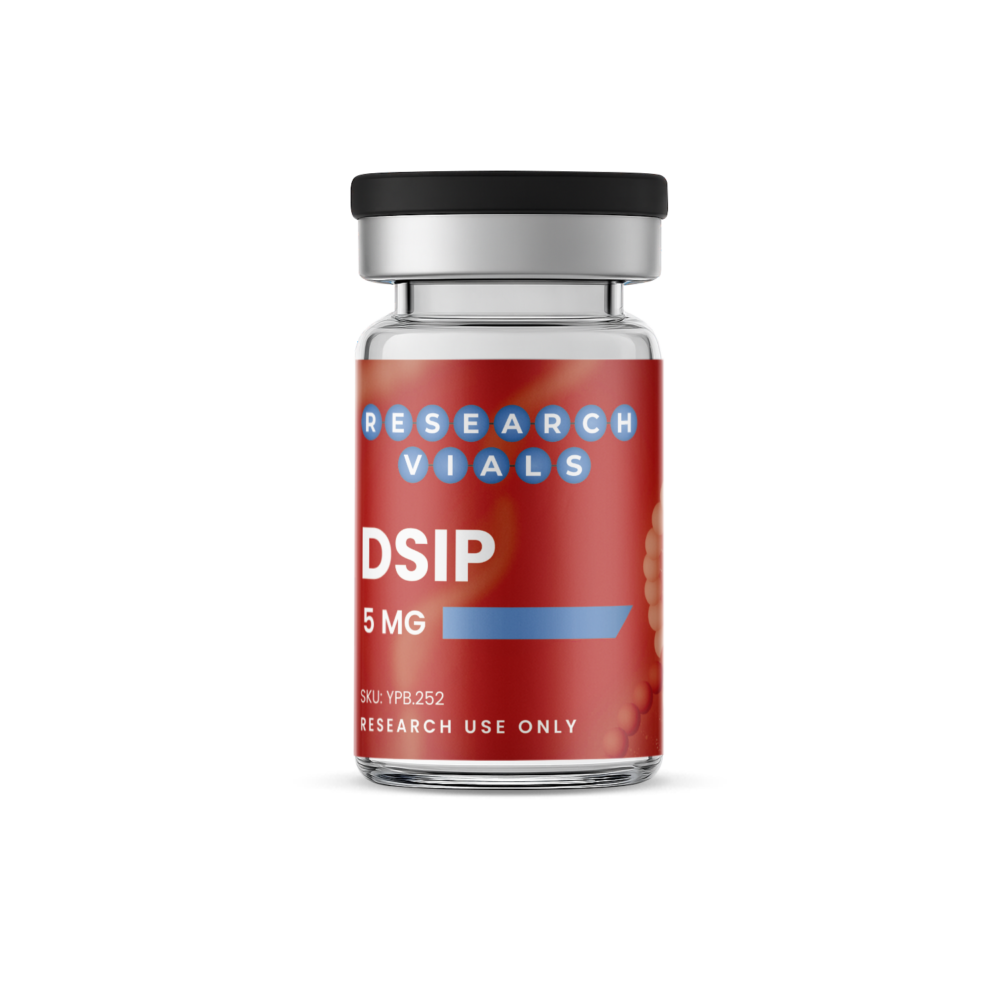
DSIP 5mg
Delta Sleep-Inducing Peptide
Trp-Ala-Gly-Gly-Asp-Ala-Ser-Gly-Glu
Overview
Delta Sleep-Inducing Peptide (DSIP) is a naturally occurring nonapeptide first isolated from rabbit brain in 1977 by Schoenenberger and Monnier. It was identified based on its ability to induce delta (slow-wave) sleep when injected into recipient rabbits. DSIP is found endogenously in both free and bound forms in human blood, and its concentrations show circadian variation, supporting a physiological role in sleep-wake regulation. The mechanism of action of DSIP remains incompletely characterized despite decades of research. It appears to act as a sleep-promoting substance that modulates rather than directly induces sleep. DSIP influences multiple neuroendocrine axes: it has been shown to modulate corticotropin (ACTH) and cortisol release, suggesting interactions with the hypothalamic-pituitary-adrenal (HPA) axis. It also affects LH secretion and has been shown to influence somatostatin and somatotropin release patterns. Beyond sleep, DSIP has been investigated for stress-protective properties. It appears to normalize disrupted circadian rhythms and has demonstrated anxiolytic-like effects in animal models. Some researchers have proposed that DSIP functions as a broad neuromodulatory factor rather than a specific sleep peptide, given its wide range of physiological effects including altered pain perception and modulation of opioid receptor activity.
Mechanism of Action
Delta Sleep-Inducing Peptide (DSIP) is a naturally occurring nonapeptide first isolated from rabbit brain in 1977 by Schoenenberger and Monnier. It was identified based on its ability to induce delta (slow-wave) sleep when injected into recipient rabbits. DSIP is found endogenously in both free and bound forms in human blood, and its concentrations show circadian variation, supporting a physiological role in sleep-wake regulation. The mechanism of action of DSIP remains incompletely characterized despite decades of research. It appears to act as a sleep-promoting substance that modulates rather than directly induces sleep. DSIP influences multiple neuroendocrine axes: it has been shown to modulate corticotropin (ACTH) and cortisol release, suggesting interactions with the hypothalamic-pituitary-adrenal (HPA) axis. It also affects LH secretion and has been shown to influence somatostatin and somatotropin release patterns. Beyond sleep, DSIP has been investigated for stress-protective properties. It appears to normalize disrupted circadian rhythms and has demonstrated anxiolytic-like effects in animal models. Some researchers have proposed that DSIP functions as a broad neuromodulatory factor rather than a specific sleep peptide, given its wide range of physiological effects including altered pain perception and modulation of opioid receptor activity.
Key Research Findings
- Schoenenberger & Monnier (1977) first isolated DSIP from rabbit cerebral venous blood during electrically induced sleep, demonstrating its ability to induce delta-wave sleep in recipient animals.
- Graf & Kastin (1984) demonstrated DSIP crosses the blood-brain barrier in mice and accumulates in specific brain regions related to sleep regulation.
- Kovalzon & Strekalova (2006) reviewed evidence showing DSIP modulates stress responses and normalizes sleep patterns disrupted by acute stress in rodent models.
- Khvatova et al. (2003) showed DSIP exhibits antioxidant properties, protecting rat brain mitochondria from oxidative damage in vitro.
Citations & References
Characterization of a delta-electroencephalogram (-sleep)-inducing peptide
Schoenenberger GA, Monnier M. — Proc Natl Acad Sci USA (1977)
Delta-sleep-inducing peptide (DSIP): a review
Graf MV, Kastin AJ. — Neurosci Biobehav Rev (1984)
Delta sleep-inducing peptide (DSIP): a still unresolved riddle
Kovalzon VM, Strekalova TV. — J Neurochem (2006)
Delta sleep inducing peptide (DSIP): effect on respiration activity in rat brain mitochondria and stress protective potency under oxidative stress
Khvatova EM, Samartsev VN, Zagoskin PP, et al. — Peptides (2003)
Dosage in Research
Human studies have used intravenous doses of 25 nmol/kg for sleep research. Animal studies typically use 10-100 nmol/kg via various routes. Intranasal administration has also been explored.
Dosage information is derived from published research literature and is presented for educational purposes only. This is not medical advice. All products are for laboratory research use only.
Storage & Handling
Store lyophilized (freeze-dried) powder at -20°C to 4°C in a dry environment protected from light. Unreconstituted peptide is stable for extended periods when stored properly.
Once reconstituted with bacteriostatic water or an appropriate solvent, store at 2-8°C and use within the timeframe specified on the Certificate of Analysis. Avoid repeated freeze-thaw cycles.
A Certificate of Analysis documenting purity, identity, and recommended storage conditions is included with every order.
Frequently Asked Questions
What is DSIP 5mg?
What purity is your DSIP 5mg?
How should I store DSIP 5mg?
Is DSIP 5mg for human use?
Where can I buy DSIP 5mg?
Research Use Only
All products are intended for laboratory research and educational purposes only. Products have not been evaluated by the FDA and are not intended for human consumption, diagnosis, treatment, or prevention of any disease. Purchasers must be 21+ and confirm research use intent.