
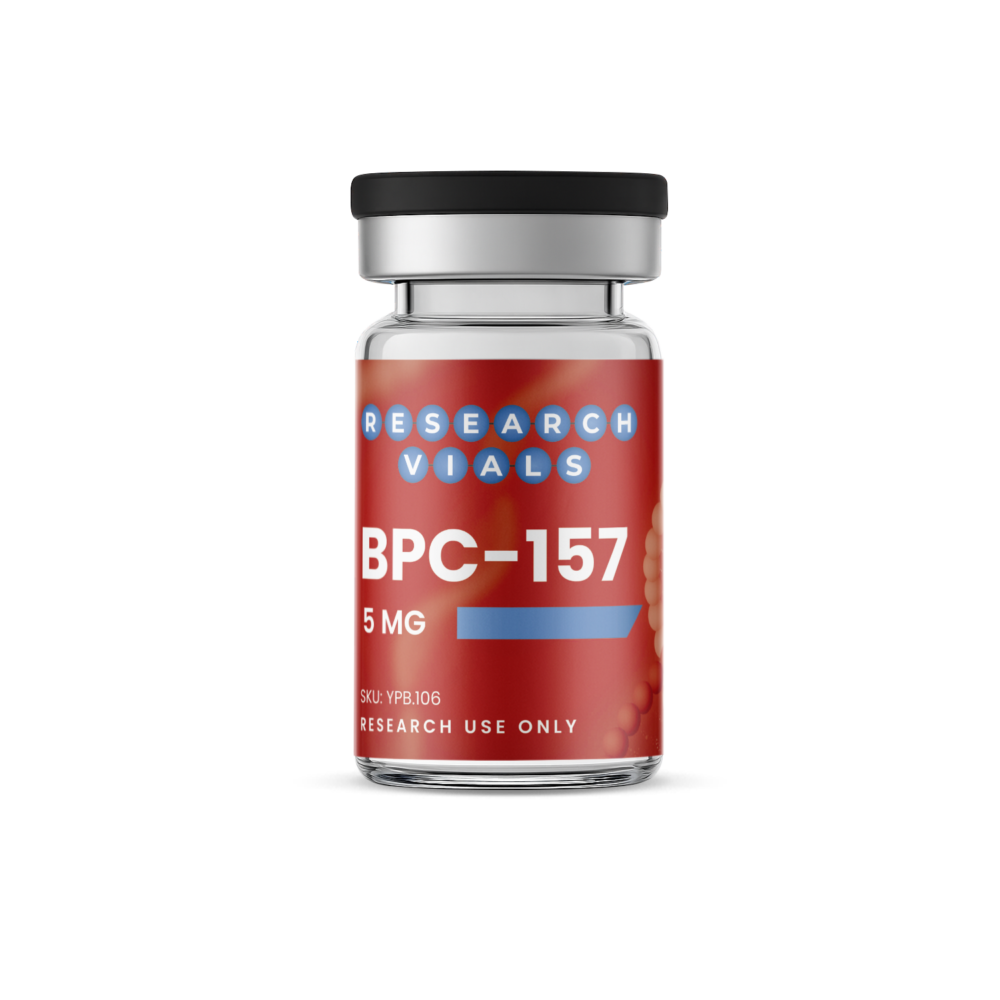
BPC 157 5mg
Body Protection Compound-157
Gly-Glu-Pro-Pro-Pro-Gly-Lys-Pro-Ala-Asp-Asp-Ala-Gly-Leu-Val
Overview
BPC-157 is a synthetic pentadecapeptide derived from a protective protein found in human gastric juice. Its mechanisms of action are multifaceted and have been studied extensively in over 100 animal studies. A central aspect of its activity involves upregulation of growth factor expression, including VEGF (vascular endothelial growth factor), EGF (epidermal growth factor), and their receptors. This pro-angiogenic activity helps explain its remarkable wound-healing and tissue-repair properties observed across multiple tissue types. BPC-157 also interacts with the nitric oxide (NO) system in a complex, context-dependent manner. It can rescue NO production when it is pathologically inhibited and can attenuate excessive NO when it is overproduced, suggesting a modulatory rather than unidirectional effect. Research by Sikiric et al. has demonstrated that BPC-157 interacts with the dopaminergic system and may counteract both the acute and chronic effects of dopaminergic agents, pointing to direct CNS activity. At the gastrointestinal level, BPC-157 maintains mucosal integrity by promoting granulation tissue formation and angiogenesis within lesion sites. It has shown cytoprotective effects against NSAID-induced gastric damage, ethanol-induced lesions, and stress ulcers in numerous rodent models. The peptide appears to modulate the FAK-paxillin pathway, which is critical for cell migration and adhesion during wound repair.
Mechanism of Action
BPC-157 is a synthetic pentadecapeptide derived from a protective protein found in human gastric juice. Its mechanisms of action are multifaceted and have been studied extensively in over 100 animal studies. A central aspect of its activity involves upregulation of growth factor expression, including VEGF (vascular endothelial growth factor), EGF (epidermal growth factor), and their receptors. This pro-angiogenic activity helps explain its remarkable wound-healing and tissue-repair properties observed across multiple tissue types. BPC-157 also interacts with the nitric oxide (NO) system in a complex, context-dependent manner. It can rescue NO production when it is pathologically inhibited and can attenuate excessive NO when it is overproduced, suggesting a modulatory rather than unidirectional effect. Research by Sikiric et al. has demonstrated that BPC-157 interacts with the dopaminergic system and may counteract both the acute and chronic effects of dopaminergic agents, pointing to direct CNS activity. At the gastrointestinal level, BPC-157 maintains mucosal integrity by promoting granulation tissue formation and angiogenesis within lesion sites. It has shown cytoprotective effects against NSAID-induced gastric damage, ethanol-induced lesions, and stress ulcers in numerous rodent models. The peptide appears to modulate the FAK-paxillin pathway, which is critical for cell migration and adhesion during wound repair.
Key Research Findings
- Sikiric et al. (2011) reviewed decades of research showing BPC-157 heals esophageal, gastric, duodenal, and colonic lesions in rodent models, with efficacy comparable to or exceeding standard treatments.
- Chang et al. (2011) demonstrated BPC-157 accelerated healing of transected Achilles tendons in rats by promoting tendon fibroblast outgrowth and VEGF expression.
- Seiwerth et al. (2014) showed BPC-157 promoted angiogenesis in a chick embryo CAM assay and accelerated cutaneous wound healing in diabetic rodent models.
- Pevec et al. (2010) found BPC-157 improved healing of medial collateral ligament injuries in rats with increased biomechanical strength at the repair site.
- Sikiric et al. (2018) demonstrated BPC-157 interacts with the NO system, rescuing impaired healing in L-NAME-treated animals and counteracting excessive NO in L-arginine models.
Citations & References
Stable gastric pentadecapeptide BPC 157: novel therapy in gastrointestinal tract
Sikiric P, Seiwerth S, Rucman R, et al. — Curr Pharm Des (2011)
The promoting effect of pentadecapeptide BPC 157 on tendon healing involves tendon outgrowth, cell survival, and cell migration
Chang CH, Tsai WC, Lin MS, et al. — J Appl Physiol (2011)
BPC 157's effect on healing
Seiwerth S, Sikiric P, Grabarevic Z, et al. — J Physiol Paris (1997)
Impact of pentadecapeptide BPC 157 on muscle healing impaired by systemic corticosteroid application
Pevec D, Novinscak T, Brcic L, et al. — Med Sci Monit (2010)
Stable gastric pentadecapeptide BPC 157, Robert's cytoprotection, and target lesion treatment: focus on gastrointestinal tract
Sikiric P, Hahm KB, Blagaic AB, et al. — Front Pharmacol (2018)
Dosage in Research
In rodent studies, BPC-157 is typically administered at 10 mcg/kg or 10 ng/kg, delivered intraperitoneally or locally at the injury site. Oral administration has also been studied for gastrointestinal applications. No human clinical trial data is currently published.
Dosage information is derived from published research literature and is presented for educational purposes only. This is not medical advice. All products are for laboratory research use only.
Storage & Handling
Store lyophilized (freeze-dried) powder at -20°C to 4°C in a dry environment protected from light. Unreconstituted peptide is stable for extended periods when stored properly.
Once reconstituted with bacteriostatic water or an appropriate solvent, store at 2-8°C and use within the timeframe specified on the Certificate of Analysis. Avoid repeated freeze-thaw cycles.
A Certificate of Analysis documenting purity, identity, and recommended storage conditions is included with every order.
Frequently Asked Questions
What is BPC 157 5mg?
What purity is your BPC 157 5mg?
How should I store BPC 157 5mg?
Is BPC 157 5mg for human use?
Where can I buy BPC 157 5mg?
Research Use Only
All products are intended for laboratory research and educational purposes only. Products have not been evaluated by the FDA and are not intended for human consumption, diagnosis, treatment, or prevention of any disease. Purchasers must be 21+ and confirm research use intent.