
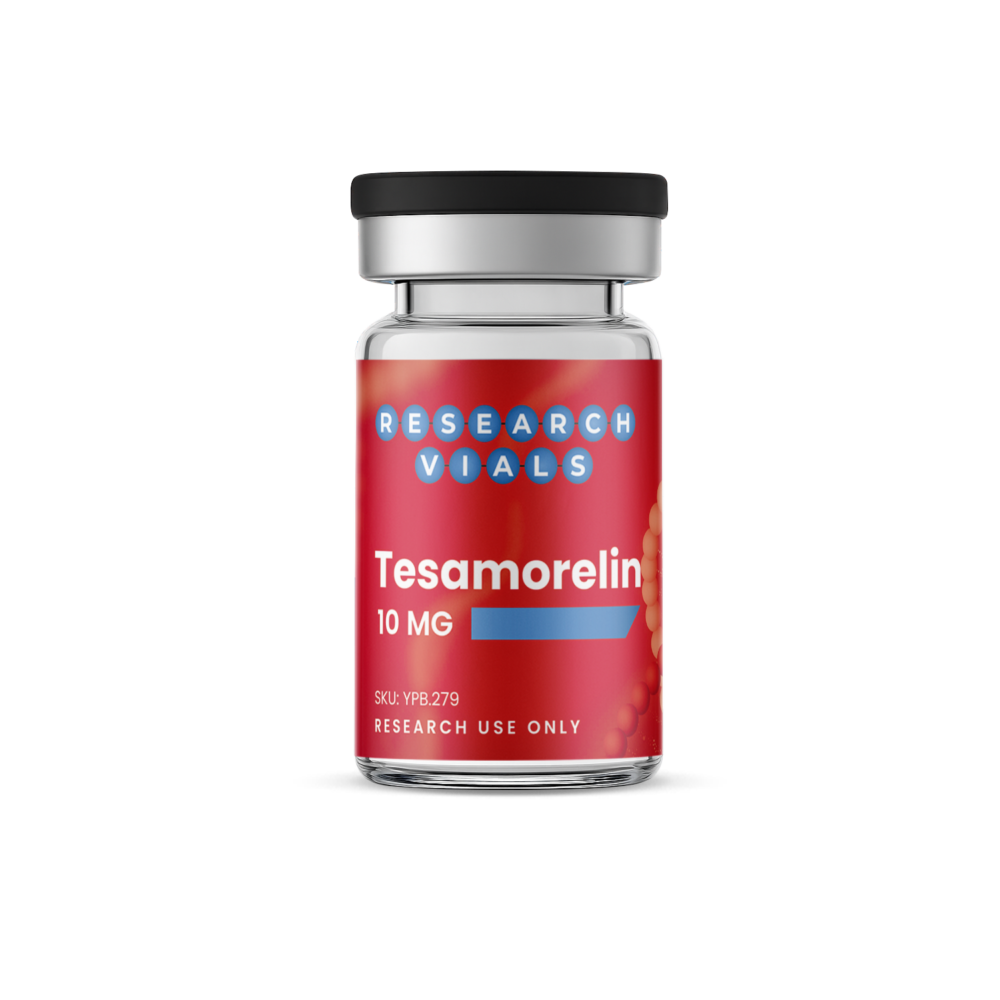
Tesamorelin (10mg)
Tesamorelin Acetate
Trans-3-hexenoic acid-Tyr-Ala-Asp-Ala-Ile-Phe-Thr-Asn-Ser-Tyr-Arg-Lys-Val-Leu-Gly-Gln-Leu-Ser-Ala-Arg-Lys-Leu-Leu-Gln-Asp-Ile-Met-Ser-Arg-Gln-Gln-Gly-Glu-Ser-Asn-Gln-Glu-Arg-Gly-Ala-Arg-Ala-Arg-Leu-NH2
Overview
Tesamorelin is a synthetic analogue of human GHRH (growth hormone-releasing hormone) comprising all 44 amino acids of native GHRH with an added trans-3-hexenoic acid moiety at the N-terminus. This modification enhances resistance to DPP-4 enzymatic degradation without altering receptor binding affinity, resulting in improved bioavailability compared to native GHRH. Tesamorelin is FDA-approved under the brand name Egrifta for the treatment of excess visceral abdominal fat in HIV-infected patients with lipodystrophy. Tesamorelin binds to GHRH receptors on anterior pituitary somatotrophs, stimulating GH synthesis and secretion through the cAMP/PKA signaling cascade. Like sermorelin, it promotes physiological pulsatile GH release while preserving somatostatin-mediated feedback regulation. The resulting GH elevation stimulates hepatic IGF-1 production and downstream metabolic effects including lipolysis, particularly in visceral adipose depots. Clinical trials demonstrated significant reductions in visceral adipose tissue (VAT) — approximately 15-18% reduction over 26 weeks in HIV lipodystrophy patients. Importantly, tesamorelin reduced VAT without significantly affecting subcutaneous fat, suggesting preferential action on metabolically active visceral depots. Additional research has explored cognitive benefits, with Stanley et al. demonstrating improved executive function and verbal memory in older adults.
Mechanism of Action
Tesamorelin is a synthetic analogue of human GHRH (growth hormone-releasing hormone) comprising all 44 amino acids of native GHRH with an added trans-3-hexenoic acid moiety at the N-terminus. This modification enhances resistance to DPP-4 enzymatic degradation without altering receptor binding affinity, resulting in improved bioavailability compared to native GHRH. Tesamorelin is FDA-approved under the brand name Egrifta for the treatment of excess visceral abdominal fat in HIV-infected patients with lipodystrophy. Tesamorelin binds to GHRH receptors on anterior pituitary somatotrophs, stimulating GH synthesis and secretion through the cAMP/PKA signaling cascade. Like sermorelin, it promotes physiological pulsatile GH release while preserving somatostatin-mediated feedback regulation. The resulting GH elevation stimulates hepatic IGF-1 production and downstream metabolic effects including lipolysis, particularly in visceral adipose depots. Clinical trials demonstrated significant reductions in visceral adipose tissue (VAT) — approximately 15-18% reduction over 26 weeks in HIV lipodystrophy patients. Importantly, tesamorelin reduced VAT without significantly affecting subcutaneous fat, suggesting preferential action on metabolically active visceral depots. Additional research has explored cognitive benefits, with Stanley et al. demonstrating improved executive function and verbal memory in older adults.
Key Research Findings
- Falutz et al. (2007) demonstrated tesamorelin reduced trunk fat by 15.2% and VAT by 18% over 26 weeks in HIV-associated lipodystrophy in the pivotal Phase III trial.
- Stanley et al. (2015) showed tesamorelin improved executive function and verbal memory in cognitively normal older adults with elevated abdominal adiposity.
- Dhillon (2011) reviewed the pharmacology of tesamorelin, confirming its mechanism through GHRH receptor agonism and its specificity for visceral fat reduction.
- Falutz et al. (2010) demonstrated that benefits of tesamorelin on VAT are maintained with continued treatment over 52 weeks.
Citations & References
Metabolic effects of a growth hormone-releasing factor in patients with HIV
Falutz J, Allas S, Blot K, et al. — N Engl J Med (2007)
Effects of a growth hormone-releasing hormone analog on endogenous GH pulsatility and insulin sensitivity in healthy older adults
Stanley TL, Chen CY, Branch KL, et al. — J Clin Endocrinol Metab (2015)
Tesamorelin: a review of its use in the management of HIV-associated lipodystrophy
Dhillon S. — Drugs (2011)
Effects of tesamorelin (TH9507), a growth hormone-releasing factor analog, in human immunodeficiency virus-infected patients with excess abdominal fat
Falutz J, Mamputu JC, Potvin D, et al. — J Clin Endocrinol Metab (2010)
Dosage in Research
The FDA-approved dose is 2 mg subcutaneously once daily. Clinical trials used 1-2 mg daily doses. Diagnostic GH stimulation protocols have also been studied.
Dosage information is derived from published research literature and is presented for educational purposes only. This is not medical advice. All products are for laboratory research use only.
Storage & Handling
Store lyophilized (freeze-dried) powder at -20°C to 4°C in a dry environment protected from light. Unreconstituted peptide is stable for extended periods when stored properly.
Once reconstituted with bacteriostatic water or an appropriate solvent, store at 2-8°C and use within the timeframe specified on the Certificate of Analysis. Avoid repeated freeze-thaw cycles.
A Certificate of Analysis documenting purity, identity, and recommended storage conditions is included with every order.
Frequently Asked Questions
What is Tesamorelin (10mg)?
What purity is your Tesamorelin (10mg)?
How should I store Tesamorelin (10mg)?
Is Tesamorelin (10mg) for human use?
Where can I buy Tesamorelin (10mg)?
Research Use Only
All products are intended for laboratory research and educational purposes only. Products have not been evaluated by the FDA and are not intended for human consumption, diagnosis, treatment, or prevention of any disease. Purchasers must be 21+ and confirm research use intent.