
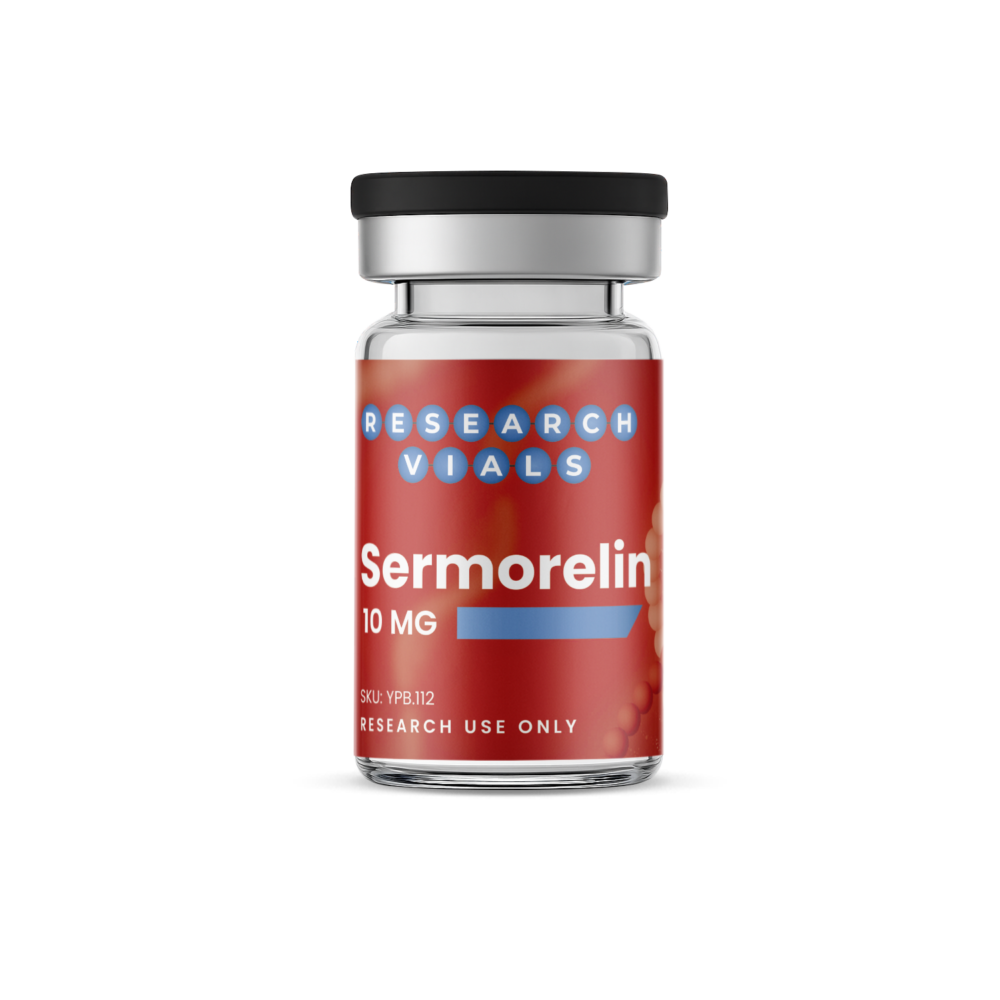
Sermorelin 10mg
Sermorelin Acetate
Tyr-Ala-Asp-Ala-Ile-Phe-Thr-Asn-Ser-Tyr-Arg-Lys-Val-Leu-Gly-Gln-Leu-Ser-Ala-Arg-Lys-Leu-Leu-Gln-Asp-Ile-Met-Ser-Arg-NH2
Overview
Sermorelin is a synthetic 29-amino-acid peptide corresponding to the first 29 residues of the 44-amino-acid human growth hormone-releasing hormone (GHRH). These first 29 amino acids contain the full biological activity of native GHRH. Sermorelin was FDA-approved in 1997 under the brand name Geref for the diagnosis and treatment of growth hormone deficiency in children, making it one of the first peptides in this class to achieve regulatory approval. Sermorelin binds to the GHRH receptor (GHRH-R) on anterior pituitary somatotroph cells. Receptor activation triggers the Gs-adenylyl cyclase-cAMP-PKA signaling cascade, which promotes GH gene transcription, GH synthesis, and GH release from secretory granules. Importantly, sermorelin stimulates physiological pulsatile GH release rather than the constant elevation seen with exogenous GH administration. This preserves the normal feedback mechanisms and circadian GH secretion pattern. A key advantage of sermorelin over direct GH administration is that it works through the body's own regulatory system. The pituitary retains the ability to modulate GH output through somatostatin-mediated negative feedback, making GH overproduction unlikely. Research in aging populations has shown sermorelin can restore more youthful GH secretion patterns, improve sleep quality (particularly slow-wave sleep, which coincides with the major nocturnal GH pulse), and improve body composition.
Mechanism of Action
Sermorelin is a synthetic 29-amino-acid peptide corresponding to the first 29 residues of the 44-amino-acid human growth hormone-releasing hormone (GHRH). These first 29 amino acids contain the full biological activity of native GHRH. Sermorelin was FDA-approved in 1997 under the brand name Geref for the diagnosis and treatment of growth hormone deficiency in children, making it one of the first peptides in this class to achieve regulatory approval. Sermorelin binds to the GHRH receptor (GHRH-R) on anterior pituitary somatotroph cells. Receptor activation triggers the Gs-adenylyl cyclase-cAMP-PKA signaling cascade, which promotes GH gene transcription, GH synthesis, and GH release from secretory granules. Importantly, sermorelin stimulates physiological pulsatile GH release rather than the constant elevation seen with exogenous GH administration. This preserves the normal feedback mechanisms and circadian GH secretion pattern. A key advantage of sermorelin over direct GH administration is that it works through the body's own regulatory system. The pituitary retains the ability to modulate GH output through somatostatin-mediated negative feedback, making GH overproduction unlikely. Research in aging populations has shown sermorelin can restore more youthful GH secretion patterns, improve sleep quality (particularly slow-wave sleep, which coincides with the major nocturnal GH pulse), and improve body composition.
Key Research Findings
- Corpas et al. (1993) showed twice-daily sermorelin administration for 14 days restored youthful GH secretion patterns in healthy elderly men, increasing 24-hour integrated GH concentrations.
- Vittone et al. (1997) demonstrated chronic sermorelin treatment improved body composition in older adults, with increased lean mass and trends toward decreased fat mass.
- Walker RF (2006) reviewed evidence that sermorelin-enhanced GH secretion improves slow-wave sleep, which declines with aging and is the phase during which the major nocturnal GH pulse occurs.
- Ionescu & Bhisitkul (2000) demonstrated sermorelin increased IGF-1 levels and growth velocity in GH-deficient children in pivotal clinical trials.
Citations & References
Growth hormone (GH)-releasing hormone-(1-29) twice daily reverses the decreased GH and insulin-like growth factor-I levels in old men
Corpas E, Harman SM, Pineyro MA, et al. — J Clin Endocrinol Metab (1992)
Effects of single nightly injections of growth hormone-releasing hormone (GHRH 1-29) in healthy elderly men
Vittone J, Blackman MR, Busby-Whitehead J, et al. — Metabolism (1997)
Sermorelin: a better approach to management of adult-onset growth hormone insufficiency?
Walker RF. — Clin Interv Aging (2006)
Dosage in Research
Clinical studies in adults used 0.5-1.0 mg subcutaneously at bedtime. Pediatric GH deficiency protocols used 30 mcg/kg/day. Diagnostic testing used single IV bolus of 1 mcg/kg.
Dosage information is derived from published research literature and is presented for educational purposes only. This is not medical advice. All products are for laboratory research use only.
Storage & Handling
Store lyophilized (freeze-dried) powder at -20°C to 4°C in a dry environment protected from light. Unreconstituted peptide is stable for extended periods when stored properly.
Once reconstituted with bacteriostatic water or an appropriate solvent, store at 2-8°C and use within the timeframe specified on the Certificate of Analysis. Avoid repeated freeze-thaw cycles.
A Certificate of Analysis documenting purity, identity, and recommended storage conditions is included with every order.
Frequently Asked Questions
What is Sermorelin 10mg?
What purity is your Sermorelin 10mg?
How should I store Sermorelin 10mg?
Is Sermorelin 10mg for human use?
Where can I buy Sermorelin 10mg?
Research Use Only
All products are intended for laboratory research and educational purposes only. Products have not been evaluated by the FDA and are not intended for human consumption, diagnosis, treatment, or prevention of any disease. Purchasers must be 21+ and confirm research use intent.