
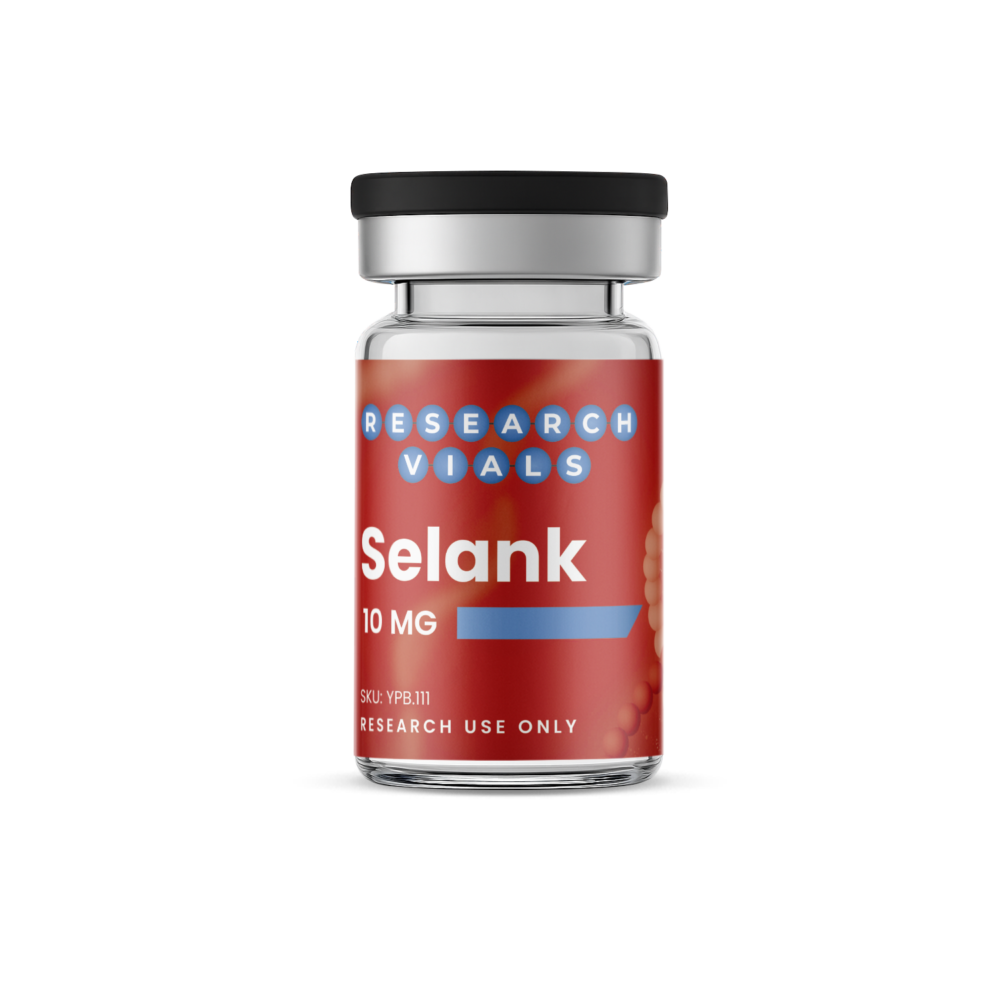
Selank 10mg
Selank (TP-7)
Thr-Lys-Pro-Arg-Pro-Gly-Pro
Overview
Selank is a synthetic heptapeptide developed at the Institute of Molecular Genetics of the Russian Academy of Sciences. It is a derivative of tuftsin (Thr-Lys-Pro-Arg), a naturally occurring immunomodulatory tetrapeptide, with an added Pro-Gly-Pro sequence that confers enhanced metabolic stability and additional neurotropic activity. Selank is approved in Russia as an anxiolytic and nootropic medication. Selank's anxiolytic mechanism involves modulation of the GABAergic system. It has been shown to allosterically enhance GABA-A receptor function and influence the expression of the GABA transporter GAT-1 gene. Unlike benzodiazepines, selank does not produce sedation, amnesia, or dependence at anxiolytic doses. Research by Seredenin et al. demonstrated that selank's anxiolytic effect is comparable to benzodiazepines in standard behavioral tests (elevated plus maze, open field) without the characteristic side effects. Beyond anxiolysis, selank influences the expression of brain-derived neurotrophic factor (BDNF) and other neurotrophins. Gene expression studies have shown it affects over 50 genes related to neuronal signaling, inflammation, and immune function. Its immunomodulatory properties are inherited from the parent molecule tuftsin and include enhancement of phagocytic activity and modulation of T-helper cell responses, making selank unique among anxiolytic compounds in its dual neuroimmune activity.
Mechanism of Action
Selank is a synthetic heptapeptide developed at the Institute of Molecular Genetics of the Russian Academy of Sciences. It is a derivative of tuftsin (Thr-Lys-Pro-Arg), a naturally occurring immunomodulatory tetrapeptide, with an added Pro-Gly-Pro sequence that confers enhanced metabolic stability and additional neurotropic activity. Selank is approved in Russia as an anxiolytic and nootropic medication. Selank's anxiolytic mechanism involves modulation of the GABAergic system. It has been shown to allosterically enhance GABA-A receptor function and influence the expression of the GABA transporter GAT-1 gene. Unlike benzodiazepines, selank does not produce sedation, amnesia, or dependence at anxiolytic doses. Research by Seredenin et al. demonstrated that selank's anxiolytic effect is comparable to benzodiazepines in standard behavioral tests (elevated plus maze, open field) without the characteristic side effects. Beyond anxiolysis, selank influences the expression of brain-derived neurotrophic factor (BDNF) and other neurotrophins. Gene expression studies have shown it affects over 50 genes related to neuronal signaling, inflammation, and immune function. Its immunomodulatory properties are inherited from the parent molecule tuftsin and include enhancement of phagocytic activity and modulation of T-helper cell responses, making selank unique among anxiolytic compounds in its dual neuroimmune activity.
Key Research Findings
- Seredenin et al. (1998) demonstrated selank produces anxiolytic effects comparable to benzodiazepines in rodent behavioral tests without sedation or memory impairment.
- Zozulya et al. (2001) showed selank modulates IL-6 and influences the balance of T-helper cell subsets, demonstrating immunomodulatory activity beyond its neurotropic effects.
- Kost et al. (2001) found selank inhibits enkephalin-degrading enzymes, potentially enhancing endogenous opioid peptide levels and contributing to its anxiolytic and mood-regulating effects.
- Uchakina et al. (2008) demonstrated selank affects the expression of genes related to GABA signaling and BDNF in hippocampal neurons.
Citations & References
Anxiolytic action of Selank
Seredenin SB, Kozlovskii II, Blednov IuA, et al. — Bull Exp Biol Med (1998)
Personality, coping style, and constitutional neuroimmunology
Zozulya AA, Gabaeva MV, Sokolov OY, et al. — J Immunotoxicol (2008)
Inhibitory effect of selank on enkephalin-degrading enzymes as a possible mechanism of its anxiolytic activity
Kost NV, Sokolov OY, Kurasova OB, et al. — Bull Exp Biol Med (2001)
Selank peptide affects genes related to neuronal activity, immunity, and metabolism
Kasian A, Kolomin T, Andreeva L, et al. — Mol Biol (2017)
Dosage in Research
Russian clinical studies used intranasal doses of 250-500 mcg per day. Animal behavioral studies typically use 100-300 mcg/kg. Intranasal administration is the most common route studied.
Dosage information is derived from published research literature and is presented for educational purposes only. This is not medical advice. All products are for laboratory research use only.
Storage & Handling
Store lyophilized (freeze-dried) powder at -20°C to 4°C in a dry environment protected from light. Unreconstituted peptide is stable for extended periods when stored properly.
Once reconstituted with bacteriostatic water or an appropriate solvent, store at 2-8°C and use within the timeframe specified on the Certificate of Analysis. Avoid repeated freeze-thaw cycles.
A Certificate of Analysis documenting purity, identity, and recommended storage conditions is included with every order.
Frequently Asked Questions
What is Selank 10mg?
What purity is your Selank 10mg?
How should I store Selank 10mg?
Is Selank 10mg for human use?
Where can I buy Selank 10mg?
Research Use Only
All products are intended for laboratory research and educational purposes only. Products have not been evaluated by the FDA and are not intended for human consumption, diagnosis, treatment, or prevention of any disease. Purchasers must be 21+ and confirm research use intent.