
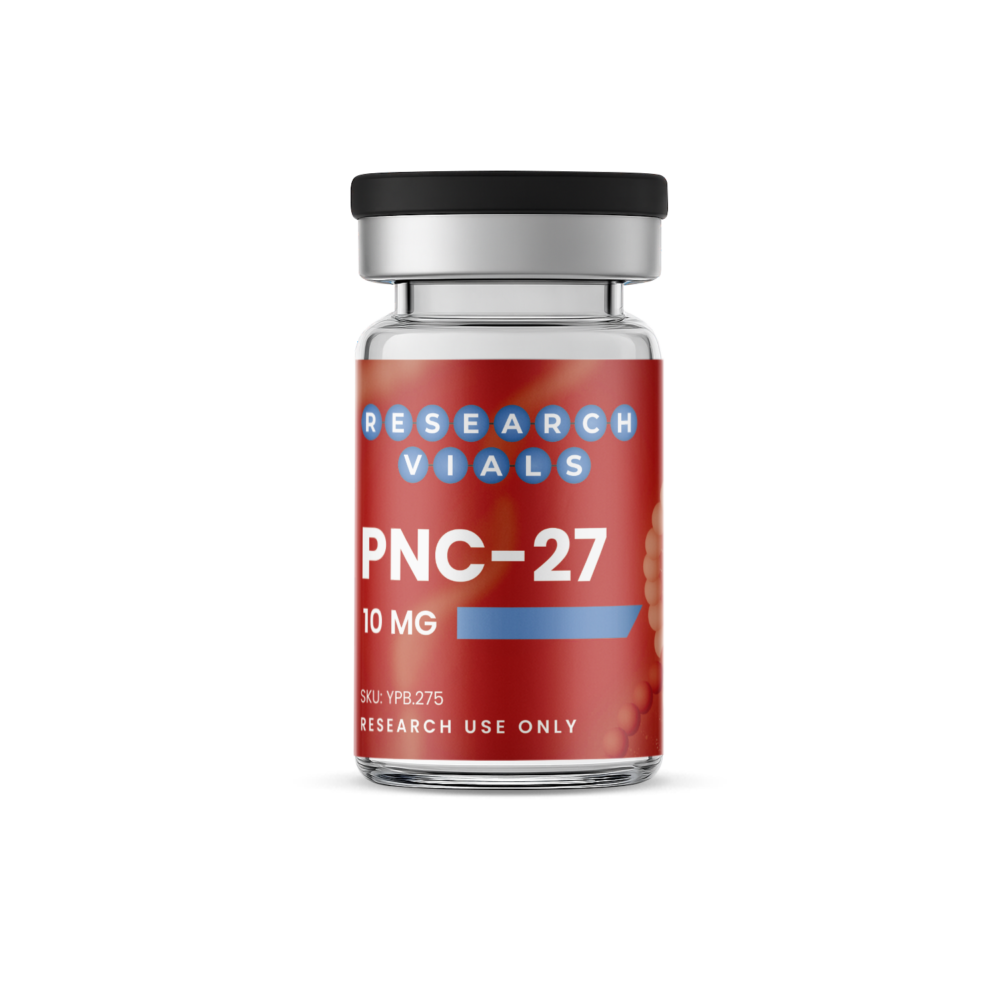
PNC-27 10mg
PNC-27
Peptide containing HDM-2 binding domain of p53 linked to a membranolytic sequence
Overview
PNC-27 is a chimeric peptide that combines a segment of the p53 tumor suppressor protein with a membrane-penetrating (membranolytic) leader sequence. The peptide was designed to selectively destroy cancer cells by exploiting a unique feature of their membrane biology: many cancer cells overexpress HDM-2 (human double minute 2, also called MDM2) on their cell surface, while normal cells keep HDM-2 intracellular. The p53-derived segment of PNC-27 contains the HDM-2 binding domain of p53 (residues 12-26). When PNC-27 encounters cancer cells with surface-exposed HDM-2, it binds HDM-2 and, through its membranolytic leader sequence, disrupts the cell membrane, causing rapid necrotic cell death. In normal cells, where HDM-2 is not expressed on the surface, PNC-27 cannot bind and therefore has no membranolytic effect. Research by Kanovsky et al. demonstrated that PNC-27 kills multiple cancer cell lines (breast, leukemia, melanoma, pancreatic) while leaving normal cells unharmed. The selectivity depends entirely on surface HDM-2 expression, which has been confirmed in multiple cancer types. This represents a unique anticancer mechanism — neither classical apoptosis induction nor immune-mediated killing, but rather physical destruction of the cancer cell membrane through targeted binding.
Mechanism of Action
PNC-27 is a chimeric peptide that combines a segment of the p53 tumor suppressor protein with a membrane-penetrating (membranolytic) leader sequence. The peptide was designed to selectively destroy cancer cells by exploiting a unique feature of their membrane biology: many cancer cells overexpress HDM-2 (human double minute 2, also called MDM2) on their cell surface, while normal cells keep HDM-2 intracellular. The p53-derived segment of PNC-27 contains the HDM-2 binding domain of p53 (residues 12-26). When PNC-27 encounters cancer cells with surface-exposed HDM-2, it binds HDM-2 and, through its membranolytic leader sequence, disrupts the cell membrane, causing rapid necrotic cell death. In normal cells, where HDM-2 is not expressed on the surface, PNC-27 cannot bind and therefore has no membranolytic effect. Research by Kanovsky et al. demonstrated that PNC-27 kills multiple cancer cell lines (breast, leukemia, melanoma, pancreatic) while leaving normal cells unharmed. The selectivity depends entirely on surface HDM-2 expression, which has been confirmed in multiple cancer types. This represents a unique anticancer mechanism — neither classical apoptosis induction nor immune-mediated killing, but rather physical destruction of the cancer cell membrane through targeted binding.
Key Research Findings
- Kanovsky et al. (2001) demonstrated PNC-27 selectively kills cancer cells expressing surface HDM-2 while leaving normal cells unharmed.
- Sookraj et al. (2010) showed PNC-27 induces rapid membrane lysis in pancreatic cancer cells through specific HDM-2 interaction.
- Sarafraz-Yazdi et al. (2010) demonstrated PNC-27 forms pores in cancer cell membranes upon HDM-2 binding, confirmed by electron microscopy.
- Do et al. (2014) showed PNC-27 reduces tumor burden in xenograft models of pancreatic cancer.
Citations & References
Peptides from the amino terminal mdm-2-binding domain of p53, designed to mimic the p53 region, kill tumor cells
Kanovsky M, Raffo A, Bhatt RR, et al. — Proc Natl Acad Sci USA (2001)
The anti-cancer peptide, PNC-27, induces tumor cell lysis as the intact peptide
Sookraj KA, Bowne WB, Adler V, et al. — Cancer Chemother Pharmacol (2010)
Anticancer peptide PNC-27 adopts an HDM-2-binding conformation and kills cancer cells by binding to HDM-2 in their membranes
Sarafraz-Yazdi E, Bowne WB, Adler V, et al. — Proc Natl Acad Sci USA (2010)
Dosage in Research
In vitro cancer cell studies use 50-200 micromolar. Xenograft studies in mice use IP injections at doses designed to achieve local tumor concentrations in this range.
Dosage information is derived from published research literature and is presented for educational purposes only. This is not medical advice. All products are for laboratory research use only.
Storage & Handling
Store lyophilized (freeze-dried) powder at -20°C to 4°C in a dry environment protected from light. Unreconstituted peptide is stable for extended periods when stored properly.
Once reconstituted with bacteriostatic water or an appropriate solvent, store at 2-8°C and use within the timeframe specified on the Certificate of Analysis. Avoid repeated freeze-thaw cycles.
A Certificate of Analysis documenting purity, identity, and recommended storage conditions is included with every order.
Frequently Asked Questions
What is PNC-27 10mg?
What purity is your PNC-27 10mg?
How should I store PNC-27 10mg?
Is PNC-27 10mg for human use?
Where can I buy PNC-27 10mg?
Research Use Only
All products are intended for laboratory research and educational purposes only. Products have not been evaluated by the FDA and are not intended for human consumption, diagnosis, treatment, or prevention of any disease. Purchasers must be 21+ and confirm research use intent.