
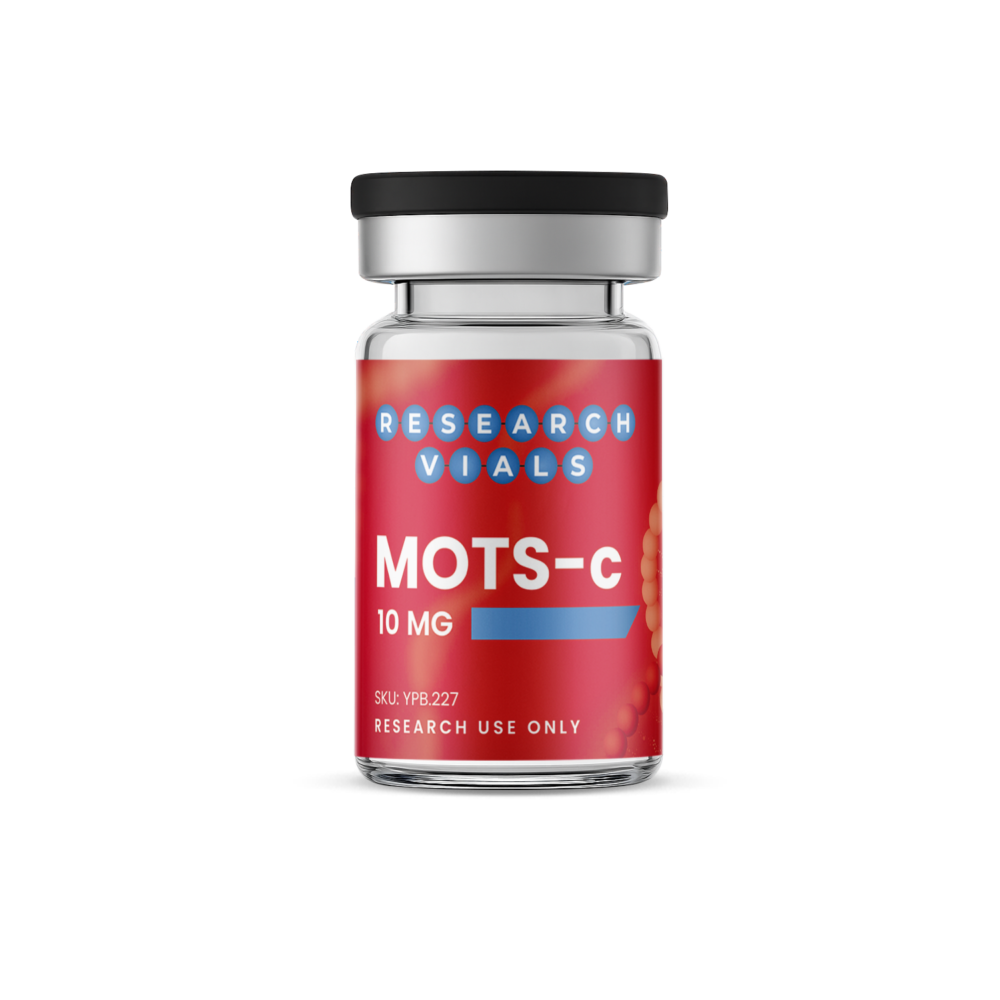
MOTS-C 10mg
MOTS-c (Mitochondrial Open Reading Frame of the 12S rRNA Type-c)
Met-Arg-Trp-Gln-Glu-Met-Gly-Tyr-Ile-Phe-Tyr-Pro-Arg-Lys-Leu-Arg
Overview
MOTS-c is a 16-amino-acid peptide encoded by the mitochondrial genome within the 12S rRNA gene. Discovered by Changhan David Lee and Pinchas Cohen at the University of Southern California in 2015, it was one of the first mitochondrial-derived peptides (MDPs) identified with significant metabolic regulatory activity. Its discovery challenged the longstanding view that the mitochondrial genome encodes only 13 proteins, 22 tRNAs, and 2 rRNAs. MOTS-c's primary mechanism involves activation of the AMPK (AMP-activated protein kinase) pathway, the master cellular energy sensor. It inhibits the folate cycle and de novo purine biosynthesis, leading to accumulation of AICAR (an endogenous AMPK activator). This AMPK activation promotes glucose uptake, fatty acid oxidation, and mitochondrial biogenesis — effects that closely mimic the metabolic benefits of exercise. Lee et al. showed that MOTS-c treatment prevented age-dependent and high-fat-diet-induced insulin resistance in mice. Remarkably, MOTS-c can translocate to the nucleus during metabolic stress, where it regulates nuclear gene expression through interaction with the antioxidant response element (ARE). This represents a novel form of mitochondrial-nuclear communication (retrograde signaling). MOTS-c levels decline with age in human plasma, and exercise has been shown to acutely increase circulating MOTS-c levels, linking it to the molecular mechanisms underlying exercise benefits.
Mechanism of Action
MOTS-c is a 16-amino-acid peptide encoded by the mitochondrial genome within the 12S rRNA gene. Discovered by Changhan David Lee and Pinchas Cohen at the University of Southern California in 2015, it was one of the first mitochondrial-derived peptides (MDPs) identified with significant metabolic regulatory activity. Its discovery challenged the longstanding view that the mitochondrial genome encodes only 13 proteins, 22 tRNAs, and 2 rRNAs. MOTS-c's primary mechanism involves activation of the AMPK (AMP-activated protein kinase) pathway, the master cellular energy sensor. It inhibits the folate cycle and de novo purine biosynthesis, leading to accumulation of AICAR (an endogenous AMPK activator). This AMPK activation promotes glucose uptake, fatty acid oxidation, and mitochondrial biogenesis — effects that closely mimic the metabolic benefits of exercise. Lee et al. showed that MOTS-c treatment prevented age-dependent and high-fat-diet-induced insulin resistance in mice. Remarkably, MOTS-c can translocate to the nucleus during metabolic stress, where it regulates nuclear gene expression through interaction with the antioxidant response element (ARE). This represents a novel form of mitochondrial-nuclear communication (retrograde signaling). MOTS-c levels decline with age in human plasma, and exercise has been shown to acutely increase circulating MOTS-c levels, linking it to the molecular mechanisms underlying exercise benefits.
Key Research Findings
- Lee et al. (2015) discovered MOTS-c and demonstrated it regulates insulin sensitivity and metabolic homeostasis through AMPK activation via folate cycle inhibition.
- Kim et al. (2018) showed MOTS-c translocates to the nucleus during metabolic stress to regulate adaptive gene expression via the ARE, establishing a new mitochondria-to-nucleus signaling pathway.
- Reynolds et al. (2021) demonstrated MOTS-c improves physical performance in young and old mice, with aged mice showing particularly robust responses.
- D'Souza et al. (2020) found circulating MOTS-c levels increase with exercise and decline with age in human subjects.
Citations & References
The mitochondrial-derived peptide MOTS-c promotes metabolic homeostasis and reduces obesity and insulin resistance
Lee C, Zeng J, Drew BG, et al. — Cell Metab (2015)
Mitochondrial-derived peptide MOTS-c translocates to the nucleus to regulate nuclear gene expression in response to metabolic stress
Kim SJ, Xiao J, Wan J, et al. — Cell Metab (2018)
MOTS-c is an exercise-induced mitochondrial-encoded regulator of age-dependent physical decline and muscle homeostasis
Reynolds JC, Lai RW, Woodhead JST, et al. — Nat Commun (2021)
Dosage in Research
Mouse studies used 5-15 mg/kg IP daily or every other day. Human dosing protocols are not yet established. The peptide has been administered both systemically and locally in preclinical models.
Dosage information is derived from published research literature and is presented for educational purposes only. This is not medical advice. All products are for laboratory research use only.
Storage & Handling
Store lyophilized (freeze-dried) powder at -20°C to 4°C in a dry environment protected from light. Unreconstituted peptide is stable for extended periods when stored properly.
Once reconstituted with bacteriostatic water or an appropriate solvent, store at 2-8°C and use within the timeframe specified on the Certificate of Analysis. Avoid repeated freeze-thaw cycles.
A Certificate of Analysis documenting purity, identity, and recommended storage conditions is included with every order.
Frequently Asked Questions
What is MOTS-C 10mg?
What purity is your MOTS-C 10mg?
How should I store MOTS-C 10mg?
Is MOTS-C 10mg for human use?
Where can I buy MOTS-C 10mg?
Research Use Only
All products are intended for laboratory research and educational purposes only. Products have not been evaluated by the FDA and are not intended for human consumption, diagnosis, treatment, or prevention of any disease. Purchasers must be 21+ and confirm research use intent.