
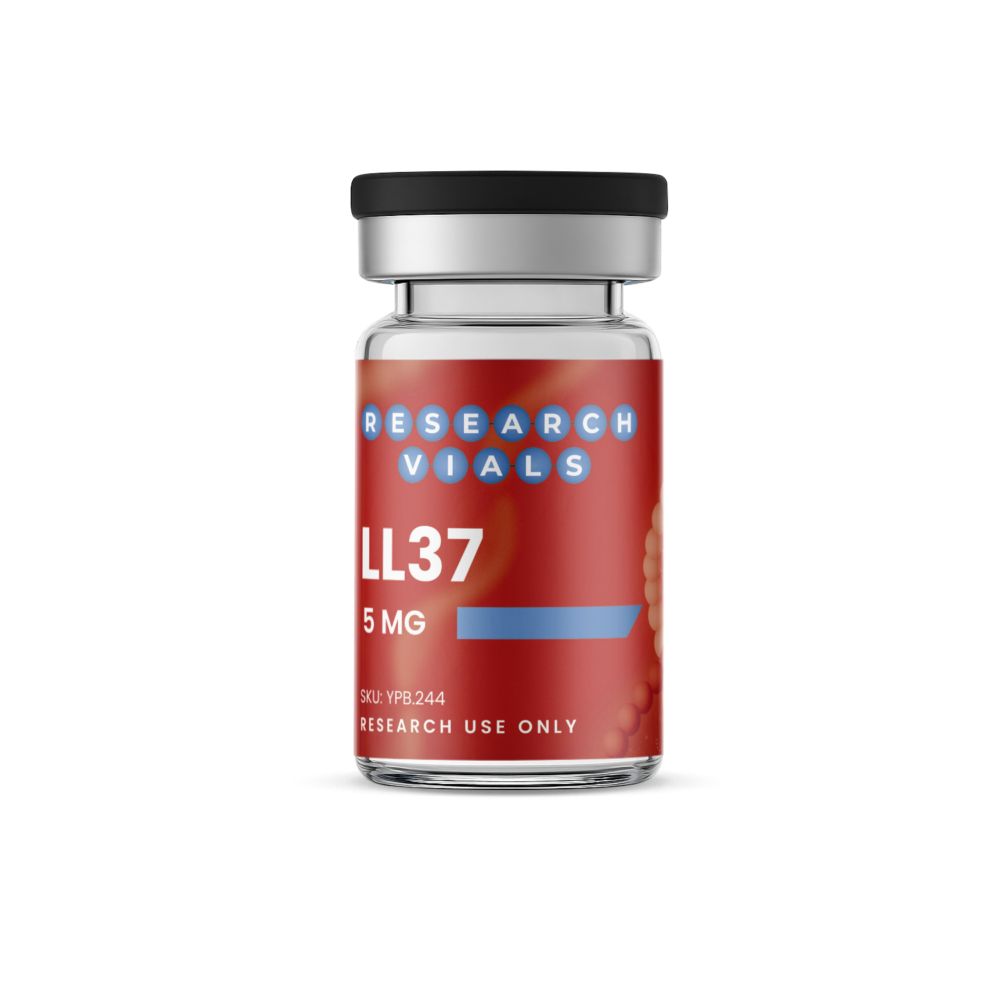
LL37 (5mg)
LL-37 (Cathelicidin)
Leu-Leu-Gly-Asp-Phe-Phe-Arg-Lys-Ser-Lys-Glu-Lys-Ile-Gly-Lys-Glu-Phe-Lys-Arg-Ile-Val-Gln-Arg-Ile-Lys-Asp-Phe-Leu-Arg-Asn-Leu-Val-Pro-Arg-Thr-Glu-Ser
Overview
LL-37 is the only human cathelicidin antimicrobial peptide, derived from the C-terminal cleavage of the 18-kDa precursor protein hCAP18 by proteinase 3. It is a 37-amino-acid amphipathic alpha-helical peptide produced by neutrophils, macrophages, epithelial cells, and other cell types as part of the innate immune defense. LL-37's antimicrobial mechanism involves direct membrane disruption of microbial cells. Its amphipathic structure — with a hydrophobic face and a cationic (positively charged) face — enables it to insert into negatively charged microbial membranes, causing pore formation and cell lysis. It is active against a broad spectrum of Gram-positive and Gram-negative bacteria, fungi, and enveloped viruses. Crucially, LL-37 also disrupts bacterial biofilms at sub-bactericidal concentrations, a property that distinguishes it from many conventional antibiotics. Beyond direct antimicrobial activity, LL-37 serves as a potent immunomodulator. It recruits immune cells to infection sites by acting as a chemoattractant for neutrophils, monocytes, and T-cells via the formyl peptide receptor-like 1 (FPRL1). It promotes wound healing by stimulating angiogenesis and re-epithelialization. LL-37 also modulates Toll-like receptor signaling, enhancing the immune response to bacterial products while dampening potentially harmful excessive inflammatory responses.
Mechanism of Action
LL-37 is the only human cathelicidin antimicrobial peptide, derived from the C-terminal cleavage of the 18-kDa precursor protein hCAP18 by proteinase 3. It is a 37-amino-acid amphipathic alpha-helical peptide produced by neutrophils, macrophages, epithelial cells, and other cell types as part of the innate immune defense. LL-37's antimicrobial mechanism involves direct membrane disruption of microbial cells. Its amphipathic structure — with a hydrophobic face and a cationic (positively charged) face — enables it to insert into negatively charged microbial membranes, causing pore formation and cell lysis. It is active against a broad spectrum of Gram-positive and Gram-negative bacteria, fungi, and enveloped viruses. Crucially, LL-37 also disrupts bacterial biofilms at sub-bactericidal concentrations, a property that distinguishes it from many conventional antibiotics. Beyond direct antimicrobial activity, LL-37 serves as a potent immunomodulator. It recruits immune cells to infection sites by acting as a chemoattractant for neutrophils, monocytes, and T-cells via the formyl peptide receptor-like 1 (FPRL1). It promotes wound healing by stimulating angiogenesis and re-epithelialization. LL-37 also modulates Toll-like receptor signaling, enhancing the immune response to bacterial products while dampening potentially harmful excessive inflammatory responses.
Key Research Findings
- Hancock & Sahl (2006) reviewed antimicrobial peptides including LL-37 as key effectors of innate immunity with direct microbicidal and immunomodulatory functions.
- Overhage et al. (2008) demonstrated LL-37 inhibits Pseudomonas aeruginosa biofilm formation at 0.5 mcg/mL — well below its bactericidal concentration — through interference with quorum sensing.
- Heilborn et al. (2003) showed LL-37 is upregulated during wound healing and promotes re-epithelialization of human skin wounds.
- Vandamme et al. (2012) reviewed LL-37's dual role as antimicrobial agent and wound healing promoter.
Citations & References
Antimicrobial and host-defense peptides as new anti-infective therapeutic strategies
Hancock RE, Sahl HG. — Nat Biotechnol (2006)
Human host defense peptide LL-37 prevents bacterial biofilm formation
Overhage J, Campisano A, Bains M, et al. — Infect Immun (2008)
The cathelicidin anti-microbial peptide LL-37 is involved in re-epithelialization of human skin wounds and is lacking in chronic ulcer epithelium
Heilborn JD, Nilsson MF, Kratz G, et al. — J Invest Dermatol (2003)
A comprehensive summary of LL-37, the factotum human cathelicidin peptide
Vandamme D, Landuyt B, Luyten W, Schoofs L. — Cell Immunol (2012)
Dosage in Research
In vitro antimicrobial studies use 1-32 mcg/mL. Anti-biofilm activity observed at 0.5-4 mcg/mL. Wound healing studies in animals use topical application of 10-100 mcg/wound.
Dosage information is derived from published research literature and is presented for educational purposes only. This is not medical advice. All products are for laboratory research use only.
Storage & Handling
Store lyophilized (freeze-dried) powder at -20°C to 4°C in a dry environment protected from light. Unreconstituted peptide is stable for extended periods when stored properly.
Once reconstituted with bacteriostatic water or an appropriate solvent, store at 2-8°C and use within the timeframe specified on the Certificate of Analysis. Avoid repeated freeze-thaw cycles.
A Certificate of Analysis documenting purity, identity, and recommended storage conditions is included with every order.
Frequently Asked Questions
What is LL37 (5mg)?
What purity is your LL37 (5mg)?
How should I store LL37 (5mg)?
Is LL37 (5mg) for human use?
Where can I buy LL37 (5mg)?
Research Use Only
All products are intended for laboratory research and educational purposes only. Products have not been evaluated by the FDA and are not intended for human consumption, diagnosis, treatment, or prevention of any disease. Purchasers must be 21+ and confirm research use intent.