
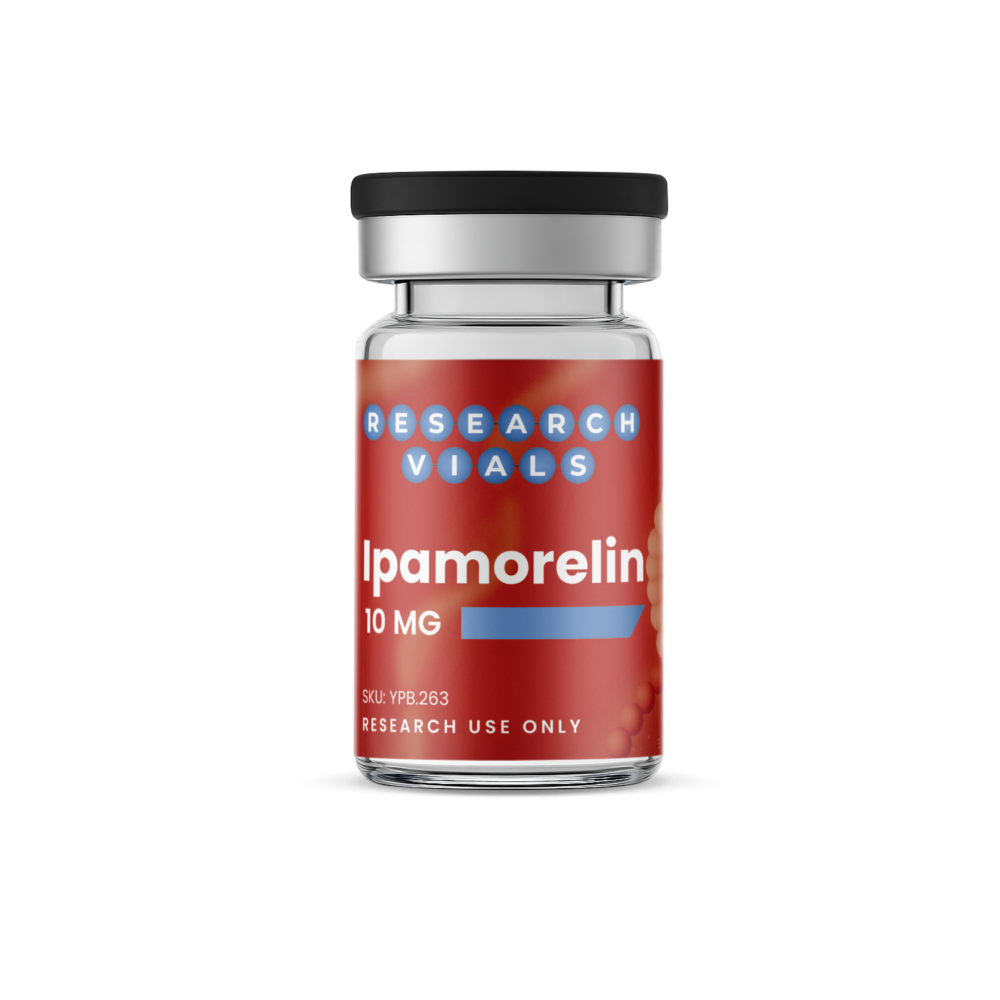
Ipamorelin (10mg)
Ipamorelin Acetate
Aib-His-D-2-Nal-D-Phe-Lys-NH2
Overview
Ipamorelin is a synthetic pentapeptide growth hormone secretagogue that acts as a selective agonist of the ghrelin/growth hormone secretagogue receptor (GHS-R1a). Unlike earlier GHS compounds such as GHRP-6 and GHRP-2, ipamorelin is notable for its high selectivity — it stimulates growth hormone release without significantly affecting cortisol, prolactin, or ACTH levels at GH-stimulating doses. This selectivity was first characterized by Raun and colleagues at Novo Nordisk in 1998. Ipamorelin binds GHS-R1a on pituitary somatotroph cells, triggering intracellular calcium influx via phospholipase C and IP3 pathways. This calcium mobilization causes GH-containing granule fusion with the cell membrane and GH exocytosis. The peptide produces dose-dependent GH release with a well-defined dose-response curve and a ceiling effect, meaning higher doses do not produce proportionally greater GH release — a property that contributes to its safety profile. Research has also explored ipamorelin's effects on gastrointestinal motility. Hansen et al. demonstrated that ipamorelin accelerates gastric emptying and colonic transit time in post-operative ileus models, leading to investigation as a potential prokinetic agent. This GI activity is mediated through ghrelin receptor activation in the enteric nervous system.
Mechanism of Action
Ipamorelin is a synthetic pentapeptide growth hormone secretagogue that acts as a selective agonist of the ghrelin/growth hormone secretagogue receptor (GHS-R1a). Unlike earlier GHS compounds such as GHRP-6 and GHRP-2, ipamorelin is notable for its high selectivity — it stimulates growth hormone release without significantly affecting cortisol, prolactin, or ACTH levels at GH-stimulating doses. This selectivity was first characterized by Raun and colleagues at Novo Nordisk in 1998. Ipamorelin binds GHS-R1a on pituitary somatotroph cells, triggering intracellular calcium influx via phospholipase C and IP3 pathways. This calcium mobilization causes GH-containing granule fusion with the cell membrane and GH exocytosis. The peptide produces dose-dependent GH release with a well-defined dose-response curve and a ceiling effect, meaning higher doses do not produce proportionally greater GH release — a property that contributes to its safety profile. Research has also explored ipamorelin's effects on gastrointestinal motility. Hansen et al. demonstrated that ipamorelin accelerates gastric emptying and colonic transit time in post-operative ileus models, leading to investigation as a potential prokinetic agent. This GI activity is mediated through ghrelin receptor activation in the enteric nervous system.
Key Research Findings
- Raun et al. (1998) demonstrated ipamorelin is the first GH secretagogue to show complete selectivity for GH release over ACTH, cortisol, and prolactin in swine models.
- Johansen et al. (1999) showed ipamorelin releases GH with efficacy and potency comparable to GHRP-6 in rats but without the broad endocrine side effects.
- Hansen et al. (2009) demonstrated ipamorelin accelerated postoperative recovery of gastrointestinal function in a rat model of post-operative ileus.
- Beck et al. (2004) showed chronic ipamorelin treatment increased bone mineral content and body weight gain in female rats without affecting blood glucose.
Citations & References
Ipamorelin, the first selective growth hormone secretagogue
Raun K, Hansen BS, Johansen NL, et al. — Eur J Endocrinol (1998)
Ipamorelin, a new growth-hormone-releasing peptide, induces longitudinal bone growth in rats
Johansen PB, Nowak J, Skjaerbaek C, et al. — Growth Horm IGF Res (1999)
Pharmacological characterisation of a new oral GH secretagogue, NN703
Hansen BS, Raun K, Nielsen KK, et al. — Eur J Endocrinol (1999)
Ghrelin as a target for gastrointestinal motility disorders
Greenwood-Van Meerveld B, Wo JM, et al. — Neurogastroenterol Motil (2011)
Dosage in Research
In animal studies, ipamorelin is typically dosed at 0.1-1 mg/kg. The selective GH release window is observed at doses up to 1 mg/kg, above which ACTH stimulation begins. Human phase II trials for post-operative ileus used IV infusions of 0.03 mg/kg/hr.
Dosage information is derived from published research literature and is presented for educational purposes only. This is not medical advice. All products are for laboratory research use only.
Storage & Handling
Store lyophilized (freeze-dried) powder at -20°C to 4°C in a dry environment protected from light. Unreconstituted peptide is stable for extended periods when stored properly.
Once reconstituted with bacteriostatic water or an appropriate solvent, store at 2-8°C and use within the timeframe specified on the Certificate of Analysis. Avoid repeated freeze-thaw cycles.
A Certificate of Analysis documenting purity, identity, and recommended storage conditions is included with every order.
Frequently Asked Questions
What is Ipamorelin (10mg)?
What purity is your Ipamorelin (10mg)?
How should I store Ipamorelin (10mg)?
Is Ipamorelin (10mg) for human use?
Where can I buy Ipamorelin (10mg)?
Research Use Only
All products are intended for laboratory research and educational purposes only. Products have not been evaluated by the FDA and are not intended for human consumption, diagnosis, treatment, or prevention of any disease. Purchasers must be 21+ and confirm research use intent.