
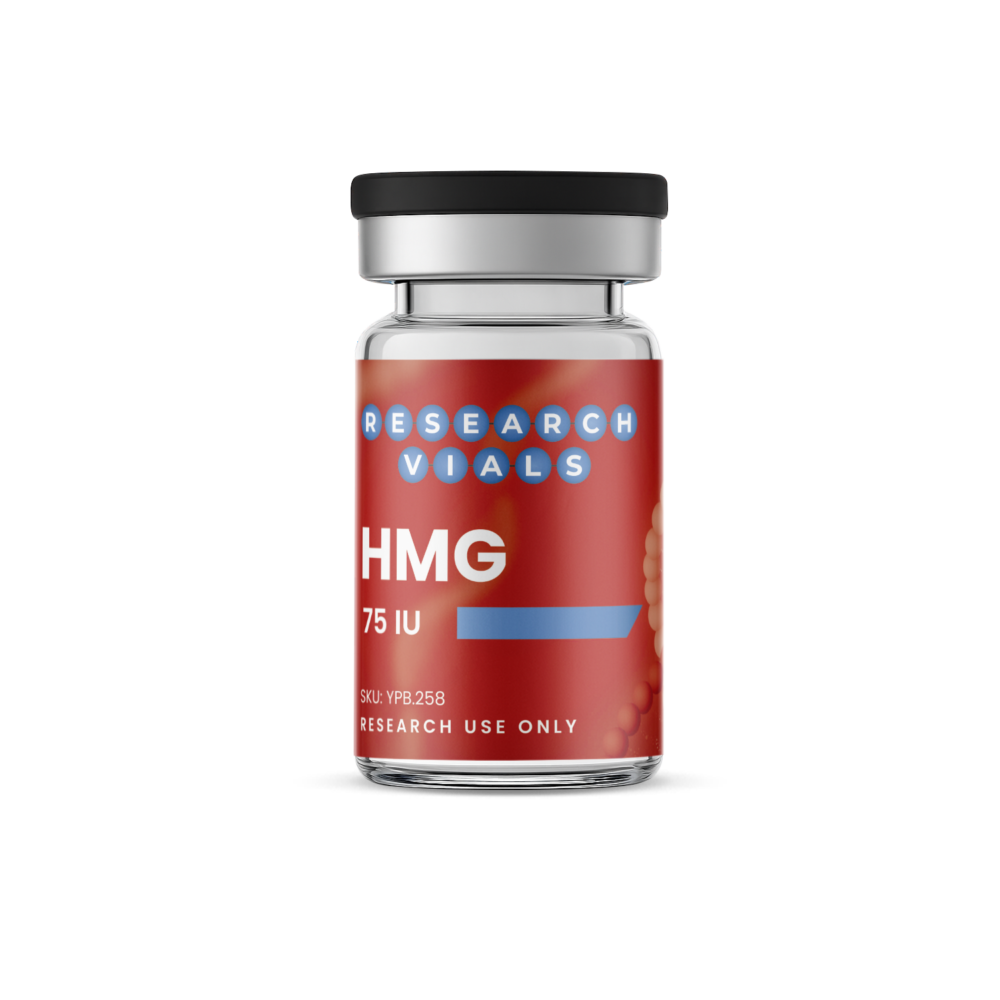
HMG 75IU
Human Menopausal Gonadotropin
Glycoprotein mixture (FSH + LH activity)
Overview
Human menopausal gonadotropin (HMG) is a purified preparation of gonadotropins containing both follicle-stimulating hormone (FSH) and luteinizing hormone (LH) activity in approximately equal proportions. Originally derived from the urine of postmenopausal women (who produce high gonadotropin levels due to lack of ovarian negative feedback), modern preparations are highly purified. FSH acts on granulosa cells of ovarian follicles (in females) or Sertoli cells of the seminiferous tubules (in males) through the FSH receptor. In females, FSH drives follicular maturation and estrogen production. In males, FSH is essential for Sertoli cell function and supports spermatogenesis. LH acts on theca cells (ovarian steroidogenesis in females) or Leydig cells (testosterone production in males) through the LH/hCG receptor. HMG has been used clinically since the 1960s for fertility treatment. In controlled ovarian hyperstimulation protocols for IVF, HMG provides both FSH (for follicular development) and LH (for appropriate steroidogenesis). The presence of LH activity distinguishes HMG from recombinant FSH preparations. Research has debated whether the LH component in HMG provides clinical advantages over pure FSH in certain patient populations, particularly older patients or those with low endogenous LH.
Mechanism of Action
Human menopausal gonadotropin (HMG) is a purified preparation of gonadotropins containing both follicle-stimulating hormone (FSH) and luteinizing hormone (LH) activity in approximately equal proportions. Originally derived from the urine of postmenopausal women (who produce high gonadotropin levels due to lack of ovarian negative feedback), modern preparations are highly purified. FSH acts on granulosa cells of ovarian follicles (in females) or Sertoli cells of the seminiferous tubules (in males) through the FSH receptor. In females, FSH drives follicular maturation and estrogen production. In males, FSH is essential for Sertoli cell function and supports spermatogenesis. LH acts on theca cells (ovarian steroidogenesis in females) or Leydig cells (testosterone production in males) through the LH/hCG receptor. HMG has been used clinically since the 1960s for fertility treatment. In controlled ovarian hyperstimulation protocols for IVF, HMG provides both FSH (for follicular development) and LH (for appropriate steroidogenesis). The presence of LH activity distinguishes HMG from recombinant FSH preparations. Research has debated whether the LH component in HMG provides clinical advantages over pure FSH in certain patient populations, particularly older patients or those with low endogenous LH.
Key Research Findings
- Lunenfeld (2004) reviewed 40 years of clinical experience with HMG, establishing it as a foundational fertility treatment used in millions of IVF cycles worldwide.
- Mochtar et al. (2007) conducted a Cochrane meta-analysis comparing HMG to recombinant FSH for IVF, finding higher live birth rates with HMG.
- Filicori et al. (2002) demonstrated that LH activity in HMG supports follicular steroidogenesis and may improve oocyte quality in certain patient populations.
- Balasch et al. (2001) showed that some women undergoing IVF have a relative LH deficiency during GnRH agonist suppression, which HMG's LH activity corrects.
Citations & References
Historical perspectives in gonadotrophin therapy
Lunenfeld B. — Hum Reprod Update (2004)
Recombinant luteinizing hormone (rLH) for controlled ovarian hyperstimulation in assisted reproductive cycles
Mochtar MH, Van der Veen F, Ziech M, van Wely M. — Cochrane Database Syst Rev (2007)
The use of LH activity to drive folliculogenesis: exploring uncharted territories in ovulation induction
Filicori M, Cognigni GE, Samara A, et al. — Hum Reprod Update (2002)
Dosage in Research
IVF protocols typically use 75-225 IU daily. Male fertility protocols use 75-150 IU three times weekly. The 75 IU vial provides a standard single dose for research protocols.
Dosage information is derived from published research literature and is presented for educational purposes only. This is not medical advice. All products are for laboratory research use only.
Storage & Handling
Store lyophilized (freeze-dried) powder at -20°C to 4°C in a dry environment protected from light. Unreconstituted peptide is stable for extended periods when stored properly.
Once reconstituted with bacteriostatic water or an appropriate solvent, store at 2-8°C and use within the timeframe specified on the Certificate of Analysis. Avoid repeated freeze-thaw cycles.
A Certificate of Analysis documenting purity, identity, and recommended storage conditions is included with every order.
Frequently Asked Questions
What is HMG 75IU?
What purity is your HMG 75IU?
How should I store HMG 75IU?
Is HMG 75IU for human use?
Where can I buy HMG 75IU?
Research Use Only
All products are intended for laboratory research and educational purposes only. Products have not been evaluated by the FDA and are not intended for human consumption, diagnosis, treatment, or prevention of any disease. Purchasers must be 21+ and confirm research use intent.