
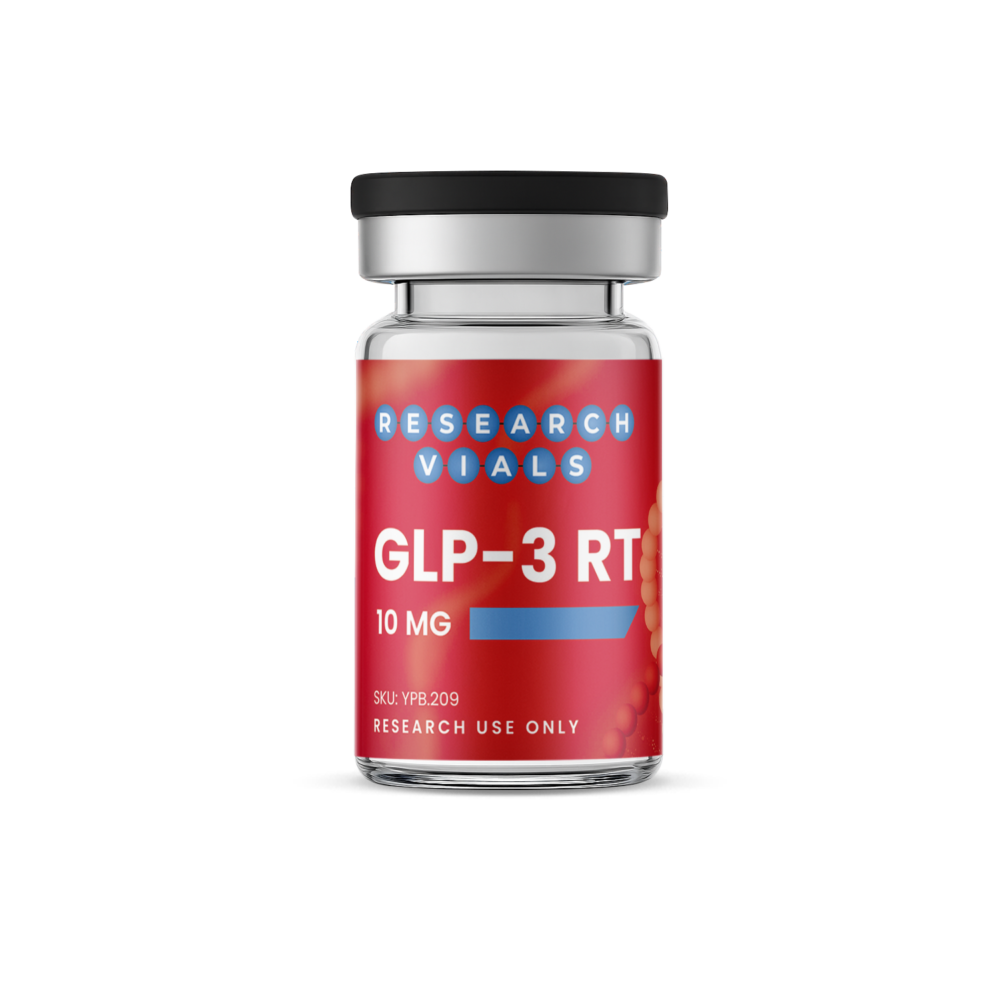
GLP-3 RT
GLP-3 RT-2 (Third-Generation Glucagon-Like Peptide Receptor Agonist)
Proprietary modified sequence
Overview
GLP-3 RT-2 represents a next-generation approach to incretin receptor agonism. While classical GLP-1 receptor agonists (like semaglutide and liraglutide) target only the GLP-1 receptor, newer research has focused on multi-receptor agonists that simultaneously engage GLP-1, GIP, and glucagon receptors. This compound is designed to leverage the growing understanding that metabolic regulation involves complex interplay between multiple incretin and glucagon pathways. The GLP-1 receptor axis, when activated, stimulates insulin secretion in a glucose-dependent manner, suppresses glucagon release, slows gastric emptying, and promotes satiety through central nervous system pathways. GIP (glucose-dependent insulinotropic polypeptide) receptor activation enhances beta-cell function and, when combined with GLP-1 activity, produces greater metabolic effects than GLP-1 alone — as demonstrated by the success of tirzepatide (a dual GIP/GLP-1 agonist). Research on this class of compounds is in relatively early stages. The rationale for multi-receptor targeting stems from clinical observations that dual and triple agonists produce superior metabolic outcomes compared to single-agonist approaches, as each receptor pathway contributes distinct physiological effects that are complementary rather than redundant.
Mechanism of Action
GLP-3 RT-2 represents a next-generation approach to incretin receptor agonism. While classical GLP-1 receptor agonists (like semaglutide and liraglutide) target only the GLP-1 receptor, newer research has focused on multi-receptor agonists that simultaneously engage GLP-1, GIP, and glucagon receptors. This compound is designed to leverage the growing understanding that metabolic regulation involves complex interplay between multiple incretin and glucagon pathways. The GLP-1 receptor axis, when activated, stimulates insulin secretion in a glucose-dependent manner, suppresses glucagon release, slows gastric emptying, and promotes satiety through central nervous system pathways. GIP (glucose-dependent insulinotropic polypeptide) receptor activation enhances beta-cell function and, when combined with GLP-1 activity, produces greater metabolic effects than GLP-1 alone — as demonstrated by the success of tirzepatide (a dual GIP/GLP-1 agonist). Research on this class of compounds is in relatively early stages. The rationale for multi-receptor targeting stems from clinical observations that dual and triple agonists produce superior metabolic outcomes compared to single-agonist approaches, as each receptor pathway contributes distinct physiological effects that are complementary rather than redundant.
Key Research Findings
- Finan et al. (2015) demonstrated that a balanced triple agonist targeting GLP-1, GIP, and glucagon receptors reduced body weight and improved metabolic parameters in diet-induced obese mice more effectively than any dual combination.
- Jastreboff et al. (2022) showed tirzepatide (dual GIP/GLP-1 agonist) produced up to 22.5% body weight reduction in the SURMOUNT-1 trial, establishing the superiority of multi-receptor approaches.
- Muller et al. (2019) reviewed the emerging paradigm of multi-receptor incretin agonism and the physiological rationale for combining GLP-1, GIP, and glucagon receptor activity.
Citations & References
A rationally designed monomeric peptide triagonist corrects obesity and diabetes in rodents
Finan B, Yang B, Ottaway N, et al. — Nat Med (2015)
Tirzepatide once weekly for the treatment of obesity
Jastreboff AM, Aronne LJ, Ahmad NN, et al. — N Engl J Med (2022)
Glucagon-like peptide 1 (GLP-1)
Muller TD, Finan B, Bloom SR, et al. — Mol Metab (2019)
Dosage in Research
As a novel research compound, standardized dosing protocols are not yet established. Related multi-receptor agonists have been studied at doses ranging from low microgram to milligram scales in preclinical models.
Dosage information is derived from published research literature and is presented for educational purposes only. This is not medical advice. All products are for laboratory research use only.
Storage & Handling
Store lyophilized (freeze-dried) powder at -20°C to 4°C in a dry environment protected from light. Unreconstituted peptide is stable for extended periods when stored properly.
Once reconstituted with bacteriostatic water or an appropriate solvent, store at 2-8°C and use within the timeframe specified on the Certificate of Analysis. Avoid repeated freeze-thaw cycles.
A Certificate of Analysis documenting purity, identity, and recommended storage conditions is included with every order.
Frequently Asked Questions
What is GLP-3 RT?
What purity is your GLP-3 RT?
How should I store GLP-3 RT?
Is GLP-3 RT for human use?
Where can I buy GLP-3 RT?
Research Use Only
All products are intended for laboratory research and educational purposes only. Products have not been evaluated by the FDA and are not intended for human consumption, diagnosis, treatment, or prevention of any disease. Purchasers must be 21+ and confirm research use intent.