
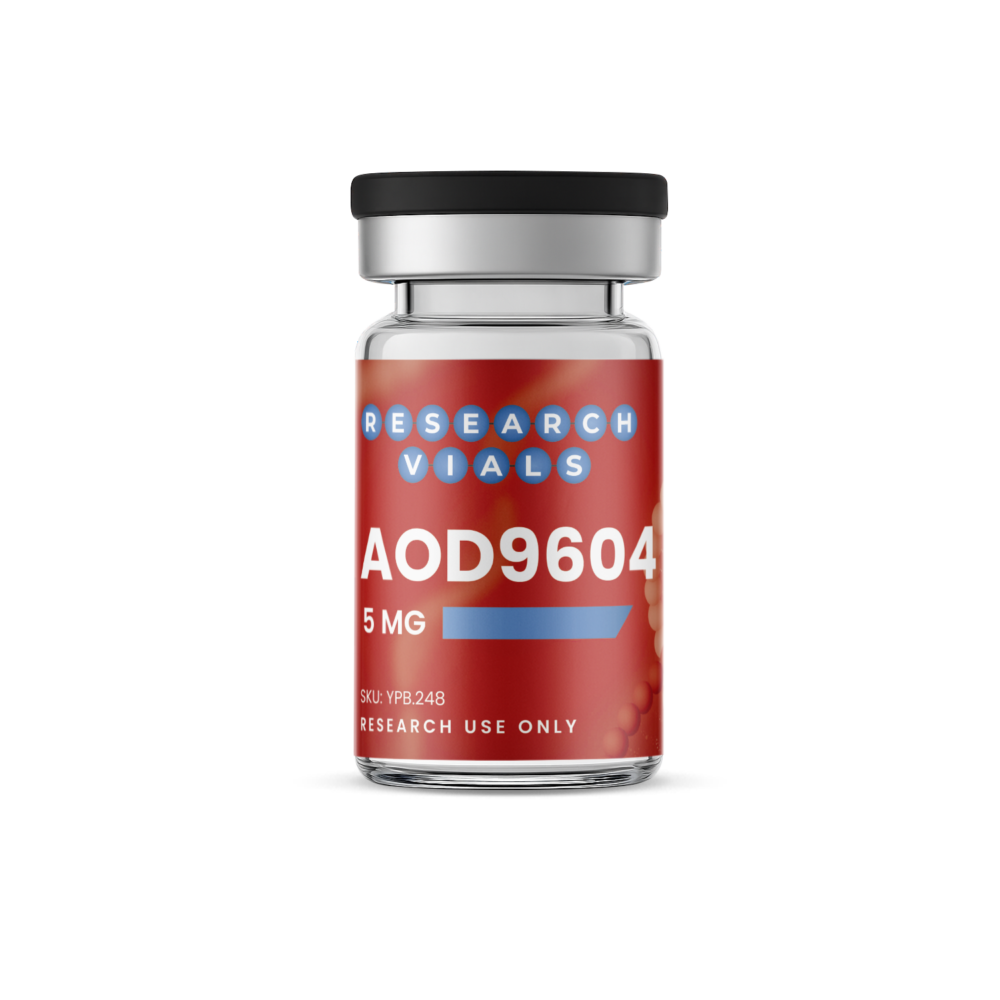
AOD 9604 (5mg)
Anti-Obesity Drug Fragment 9604
Tyr-Leu-Arg-Ile-Val-Gln-Cys-Arg-Ser-Val-Glu-Gly-Ser-Cys-Gly-Phe
Overview
AOD-9604 is a modified fragment of human growth hormone (hGH) spanning amino acids 176-191, with an added tyrosine at the N-terminus to enhance stability. It was developed to isolate the lipolytic (fat-burning) activity of growth hormone from its growth-promoting and diabetogenic effects. The peptide stimulates lipolysis and inhibits lipogenesis through a mechanism distinct from the GH receptor, and notably does not induce IGF-1 production or affect blood glucose homeostasis. The mechanism appears to involve activation of beta-3 adrenergic receptor-related pathways in adipose tissue. Research by Ng and colleagues demonstrated that AOD-9604 mimics the way natural growth hormone regulates fat metabolism — it stimulates the breakdown of stored triglycerides in adipocytes while simultaneously blocking the formation of new fat. Importantly, studies have confirmed it does not compete with hGH for receptor binding, suggesting it acts through an independent signaling pathway. More recent research has explored AOD-9604's effects on cartilage. Studies have shown it may promote proteoglycan and collagen synthesis in chondrocytes, opening potential applications in osteoarthritis research beyond its original anti-obesity focus.
Mechanism of Action
AOD-9604 is a modified fragment of human growth hormone (hGH) spanning amino acids 176-191, with an added tyrosine at the N-terminus to enhance stability. It was developed to isolate the lipolytic (fat-burning) activity of growth hormone from its growth-promoting and diabetogenic effects. The peptide stimulates lipolysis and inhibits lipogenesis through a mechanism distinct from the GH receptor, and notably does not induce IGF-1 production or affect blood glucose homeostasis. The mechanism appears to involve activation of beta-3 adrenergic receptor-related pathways in adipose tissue. Research by Ng and colleagues demonstrated that AOD-9604 mimics the way natural growth hormone regulates fat metabolism — it stimulates the breakdown of stored triglycerides in adipocytes while simultaneously blocking the formation of new fat. Importantly, studies have confirmed it does not compete with hGH for receptor binding, suggesting it acts through an independent signaling pathway. More recent research has explored AOD-9604's effects on cartilage. Studies have shown it may promote proteoglycan and collagen synthesis in chondrocytes, opening potential applications in osteoarthritis research beyond its original anti-obesity focus.
Key Research Findings
- Ng et al. (2000) demonstrated AOD-9604 reduced body weight gain in obese Zucker rats without affecting IGF-1 levels or inducing glucose intolerance.
- Heffernan et al. (2001) showed the fragment stimulated lipolysis in both human and murine adipose tissue explants in a dose-dependent manner.
- Stier et al. (2012) found AOD-9604 promoted chondrocyte proliferation and extracellular matrix synthesis in cartilage tissue models.
- Ng & Borgeaud (2000) confirmed AOD-9604 does not bind the GH receptor and operates through an independent signal transduction mechanism.
Citations & References
Metabolic studies of a synthetic lipolytic domain (AOD9604) of human growth hormone
Ng FM, Sun J, Sharma L, et al. — Horm Res (2000)
Increase of fat oxidation and weight loss in obese mice by chronic treatment with human growth hormone or a modified C-terminal fragment
Heffernan MA, Thorburn AW, Fam B, et al. — Int J Obes Relat Metab Disord (2001)
Safety and tolerability of the hexadecapeptide AOD9604 in humans
Stier H, Vos E, Kenley D. — J Endocrinol Invest (2013)
Dosage in Research
Preclinical studies have used doses ranging from 50-500 mcg/kg in animal models. A Phase IIb human clinical trial studied oral doses of 1 mg, 5 mg, 10 mg, and 20 mg daily over 12 weeks.
Dosage information is derived from published research literature and is presented for educational purposes only. This is not medical advice. All products are for laboratory research use only.
Storage & Handling
Store lyophilized (freeze-dried) powder at -20°C to 4°C in a dry environment protected from light. Unreconstituted peptide is stable for extended periods when stored properly.
Once reconstituted with bacteriostatic water or an appropriate solvent, store at 2-8°C and use within the timeframe specified on the Certificate of Analysis. Avoid repeated freeze-thaw cycles.
A Certificate of Analysis documenting purity, identity, and recommended storage conditions is included with every order.
Frequently Asked Questions
What is AOD 9604 (5mg)?
What purity is your AOD 9604 (5mg)?
How should I store AOD 9604 (5mg)?
Is AOD 9604 (5mg) for human use?
Where can I buy AOD 9604 (5mg)?
Research Use Only
All products are intended for laboratory research and educational purposes only. Products have not been evaluated by the FDA and are not intended for human consumption, diagnosis, treatment, or prevention of any disease. Purchasers must be 21+ and confirm research use intent.