
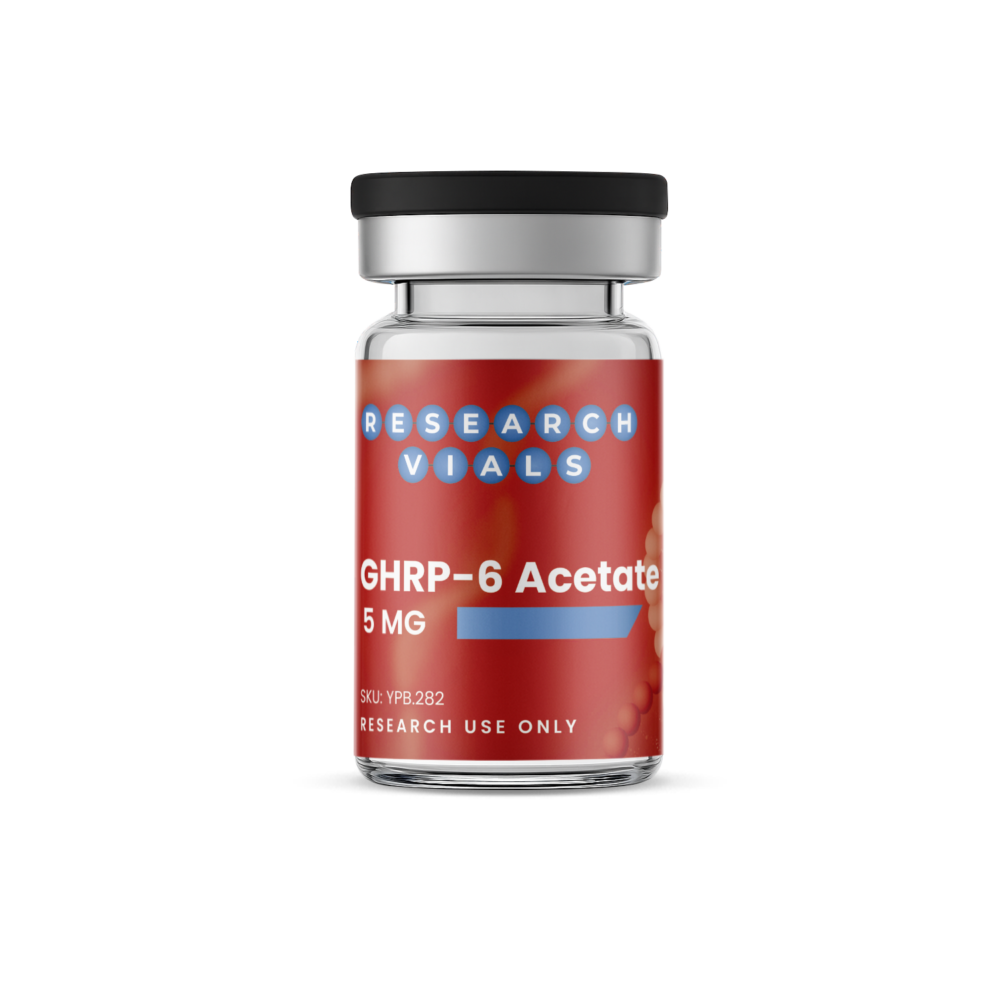
GHRP-6 Acetate 5mg
Growth Hormone-Releasing Peptide 6 Acetate
His-D-Trp-Ala-Trp-D-Phe-Lys-NH2
Overview
GHRP-6 is one of the earliest synthetic growth hormone secretagogues, developed in the 1980s by Cyril Bowers. It is a synthetic hexapeptide that acts as a potent agonist of the ghrelin receptor (GHS-R1a) on pituitary somatotrophs. GHRP-6 was instrumental in the discovery and characterization of the ghrelin receptor system — the receptor was originally identified as the 'GHRP receptor' before its natural ligand ghrelin was discovered in 1999 by Kojima et al. GHRP-6 stimulates GH release through GHS-R1a-mediated calcium signaling in somatotroph cells. Unlike the more selective ipamorelin, GHRP-6 also significantly stimulates appetite (through hypothalamic GHS-R1a), increases ACTH and cortisol to a moderate degree, and can elevate prolactin levels. Its appetite-stimulating effect is substantial and is mediated through the same ghrelin receptor pathway that mediates natural hunger signaling. Beyond GH secretion, GHRP-6 has demonstrated cytoprotective properties. Research has shown it protects against ischemia-reperfusion injury in cardiac, hepatic, and intestinal tissues. These protective effects appear to involve upregulation of antioxidant enzymes and suppression of inflammatory signaling, and may be partially mediated through GHS-R1a-independent mechanisms.
Mechanism of Action
GHRP-6 is one of the earliest synthetic growth hormone secretagogues, developed in the 1980s by Cyril Bowers. It is a synthetic hexapeptide that acts as a potent agonist of the ghrelin receptor (GHS-R1a) on pituitary somatotrophs. GHRP-6 was instrumental in the discovery and characterization of the ghrelin receptor system — the receptor was originally identified as the 'GHRP receptor' before its natural ligand ghrelin was discovered in 1999 by Kojima et al. GHRP-6 stimulates GH release through GHS-R1a-mediated calcium signaling in somatotroph cells. Unlike the more selective ipamorelin, GHRP-6 also significantly stimulates appetite (through hypothalamic GHS-R1a), increases ACTH and cortisol to a moderate degree, and can elevate prolactin levels. Its appetite-stimulating effect is substantial and is mediated through the same ghrelin receptor pathway that mediates natural hunger signaling. Beyond GH secretion, GHRP-6 has demonstrated cytoprotective properties. Research has shown it protects against ischemia-reperfusion injury in cardiac, hepatic, and intestinal tissues. These protective effects appear to involve upregulation of antioxidant enzymes and suppression of inflammatory signaling, and may be partially mediated through GHS-R1a-independent mechanisms.
Key Research Findings
- Bowers et al. (1984) developed GHRP-6 and demonstrated its potent GH-releasing activity, laying the groundwork for the entire GH secretagogue field.
- Kojima et al. (1999) discovered ghrelin as the endogenous ligand for the receptor originally identified through GHRP-6 binding studies.
- Berlanga et al. (2007) demonstrated GHRP-6 has cytoprotective effects in liver ischemia-reperfusion injury independent of GH release.
- Arvat et al. (1997) characterized the dose-response relationship for GHRP-6-induced GH, ACTH, cortisol, and prolactin release in humans.
Citations & References
On the in vitro and in vivo activity of a new synthetic hexapeptide that acts on the pituitary to specifically release growth hormone
Bowers CY, Momany FA, Reynolds GA, Hong A. — Endocrinology (1984)
Ghrelin is a growth-hormone-releasing acylated peptide from stomach
Kojima M, Hosoda H, Date Y, et al. — Nature (1999)
Growth-hormone-releasing peptide 6 (GHRP-6) prevents oxidant cytotoxicity and reduces myocardial necrosis in a model of acute myocardial infarction
Berlanga J, Cibrian D, Guevara L, et al. — Clin Sci (2007)
Dosage in Research
Human GH stimulation studies use 1-2 mcg/kg IV or SC. Cytoprotective studies in rats use 100-400 mcg/kg. Appetite stimulation occurs at standard GH-releasing doses.
Dosage information is derived from published research literature and is presented for educational purposes only. This is not medical advice. All products are for laboratory research use only.
Storage & Handling
Store lyophilized (freeze-dried) powder at -20°C to 4°C in a dry environment protected from light. Unreconstituted peptide is stable for extended periods when stored properly.
Once reconstituted with bacteriostatic water or an appropriate solvent, store at 2-8°C and use within the timeframe specified on the Certificate of Analysis. Avoid repeated freeze-thaw cycles.
A Certificate of Analysis documenting purity, identity, and recommended storage conditions is included with every order.
Frequently Asked Questions
What is GHRP-6 Acetate 5mg?
What purity is your GHRP-6 Acetate 5mg?
How should I store GHRP-6 Acetate 5mg?
Is GHRP-6 Acetate 5mg for human use?
Where can I buy GHRP-6 Acetate 5mg?
Research Use Only
All products are intended for laboratory research and educational purposes only. Products have not been evaluated by the FDA and are not intended for human consumption, diagnosis, treatment, or prevention of any disease. Purchasers must be 21+ and confirm research use intent.