
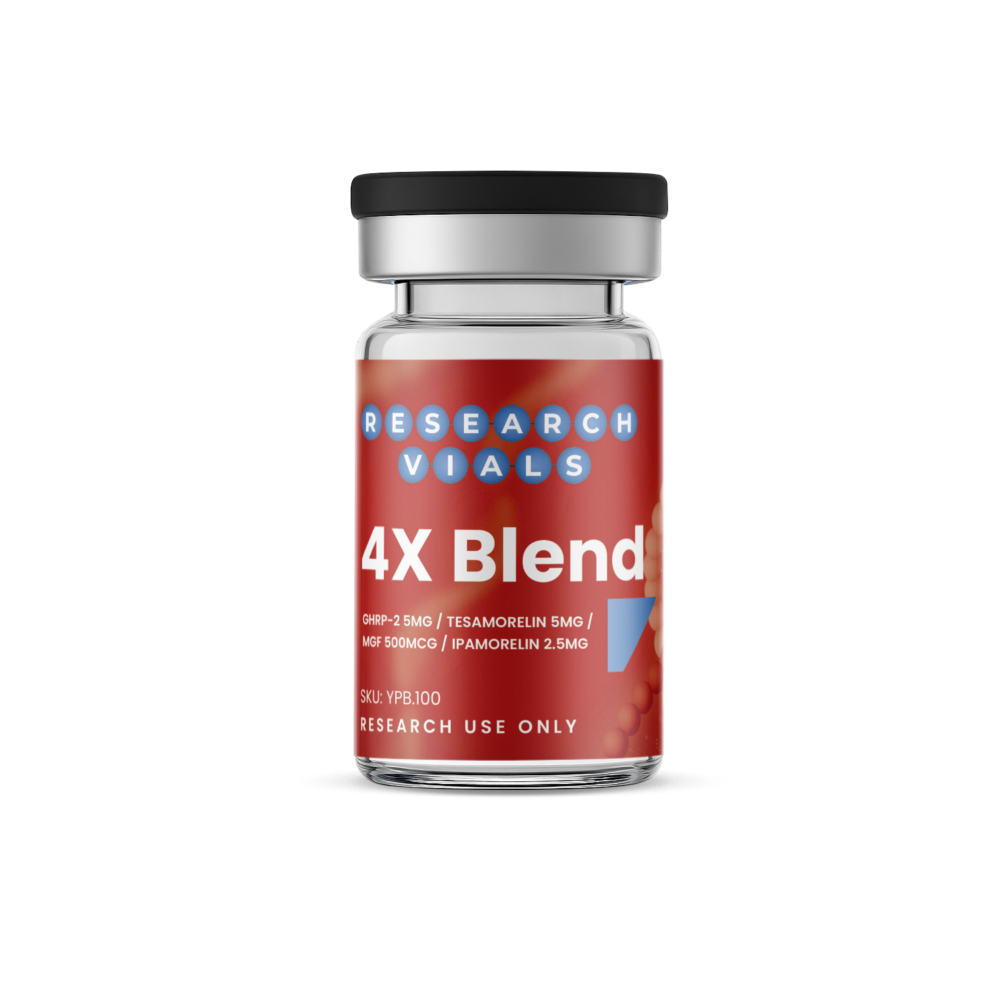
4X Blend GHRP-2/Tesamorelin/MGF/Ipamorelin
4X Growth Hormone Secretagogue Blend (GHRP-2/Tesamorelin/MGF/Ipamorelin)
Blend - multiple peptide sequences
Overview
This four-peptide blend combines complementary growth hormone secretagogue (GHS) pathways to produce a synergistic effect on GH release. GHRP-2 acts as a potent ghrelin receptor (GHS-R1a) agonist that directly stimulates somatotroph cells in the anterior pituitary, while also suppressing somatostatin signaling. Tesamorelin is a synthetic analogue of growth hormone-releasing hormone (GHRH) that binds the GHRH receptor to stimulate pulsatile GH secretion through the cAMP/PKA signaling cascade. Ipamorelin is a selective GHS-R1a agonist notable for its specificity — it stimulates GH release without significantly affecting cortisol or prolactin levels, unlike less selective secretagogues. Mechano Growth Factor (MGF), a splice variant of IGF-1 (IGF-1Ec), acts downstream by activating satellite cells and promoting local tissue repair independent of circulating GH. The rationale for combining these four peptides lies in the well-documented synergy between GHRH-pathway agonists (tesamorelin) and ghrelin-pathway agonists (GHRP-2, ipamorelin). Research by Bowers et al. demonstrated that combined GHRH and GHRP administration produces GH release far exceeding the sum of individual responses. The addition of MGF introduces a local tissue-level growth factor that operates through a distinct mechanism, broadening the biological scope of the blend.
Mechanism of Action
This four-peptide blend combines complementary growth hormone secretagogue (GHS) pathways to produce a synergistic effect on GH release. GHRP-2 acts as a potent ghrelin receptor (GHS-R1a) agonist that directly stimulates somatotroph cells in the anterior pituitary, while also suppressing somatostatin signaling. Tesamorelin is a synthetic analogue of growth hormone-releasing hormone (GHRH) that binds the GHRH receptor to stimulate pulsatile GH secretion through the cAMP/PKA signaling cascade. Ipamorelin is a selective GHS-R1a agonist notable for its specificity — it stimulates GH release without significantly affecting cortisol or prolactin levels, unlike less selective secretagogues. Mechano Growth Factor (MGF), a splice variant of IGF-1 (IGF-1Ec), acts downstream by activating satellite cells and promoting local tissue repair independent of circulating GH. The rationale for combining these four peptides lies in the well-documented synergy between GHRH-pathway agonists (tesamorelin) and ghrelin-pathway agonists (GHRP-2, ipamorelin). Research by Bowers et al. demonstrated that combined GHRH and GHRP administration produces GH release far exceeding the sum of individual responses. The addition of MGF introduces a local tissue-level growth factor that operates through a distinct mechanism, broadening the biological scope of the blend.
Key Research Findings
- Bowers et al. (1990) demonstrated synergistic GH release when GHRH and GHRP peptides are co-administered, with combined output exceeding additive predictions by 2-3 fold.
- Falutz et al. (2007) showed tesamorelin significantly reduced visceral adipose tissue in HIV-associated lipodystrophy over 26 weeks in a Phase III trial.
- Raun et al. (1998) demonstrated ipamorelin produces dose-dependent GH release in rats comparable to GHRP-6 but without affecting ACTH or cortisol.
- Yang & Bhatt (2006) found MGF (IGF-1Ec) activates muscle satellite cells and promotes myoblast proliferation independently of mature IGF-1.
Citations & References
On the in vitro and in vivo activity of a new synthetic hexapeptide that acts on the pituitary to specifically release growth hormone
Bowers CY, Momany FA, Reynolds GA, Hong A. — Endocrinology (1984)
Metabolic effects of a growth hormone-releasing factor in patients with HIV
Falutz J, Allas S, Blot K, et al. — N Engl J Med (2007)
Ipamorelin, the first selective growth hormone secretagogue
Raun K, Hansen BS, Johansen NL, et al. — Eur J Endocrinol (1998)
Different roles of the IGF-I Ec peptide (MGF) and mature IGF-I in myoblast proliferation and differentiation
Yang SY, Goldspink G. — FEBS Lett (2002)
Dosage in Research
Research protocols typically study each component individually. GHRP-2 is commonly studied at 1-2 mcg/kg; tesamorelin at 1-2 mg; ipamorelin at 1 mcg/kg; MGF at 50-200 mcg. Blend ratios vary by protocol.
Dosage information is derived from published research literature and is presented for educational purposes only. This is not medical advice. All products are for laboratory research use only.
Storage & Handling
Store lyophilized (freeze-dried) powder at -20°C to 4°C in a dry environment protected from light. Unreconstituted peptide is stable for extended periods when stored properly.
Once reconstituted with bacteriostatic water or an appropriate solvent, store at 2-8°C and use within the timeframe specified on the Certificate of Analysis. Avoid repeated freeze-thaw cycles.
A Certificate of Analysis documenting purity, identity, and recommended storage conditions is included with every order.
Frequently Asked Questions
What is 4X Blend GHRP-2/Tesamorelin/MGF/Ipamorelin?
What purity is your 4X Blend GHRP-2/Tesamorelin/MGF/Ipamorelin?
How should I store 4X Blend GHRP-2/Tesamorelin/MGF/Ipamorelin?
Is 4X Blend GHRP-2/Tesamorelin/MGF/Ipamorelin for human use?
Where can I buy 4X Blend GHRP-2/Tesamorelin/MGF/Ipamorelin?
Research Use Only
All products are intended for laboratory research and educational purposes only. Products have not been evaluated by the FDA and are not intended for human consumption, diagnosis, treatment, or prevention of any disease. Purchasers must be 21+ and confirm research use intent.