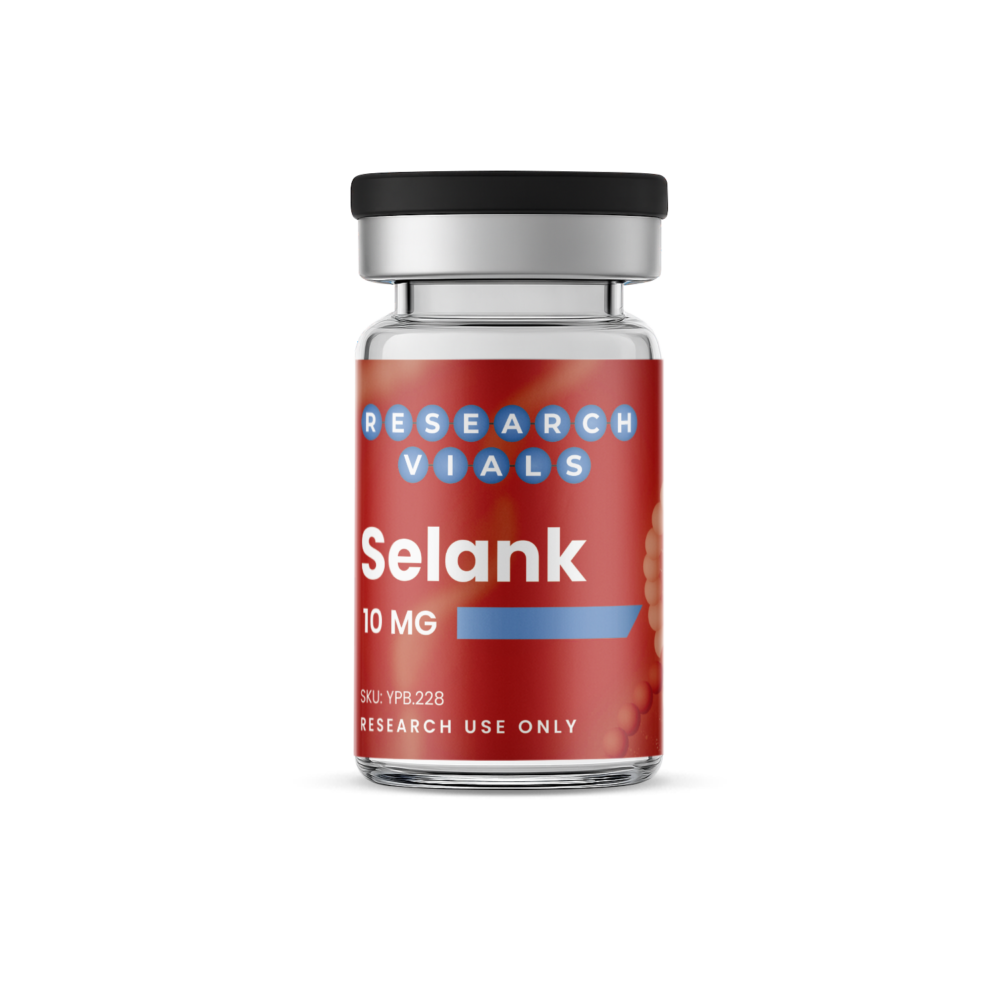
Selank represents one of the few peptide compounds studied simultaneously for both anxiolytic and cognitive-enhancing properties. Developed at the Institute of Molecular Genetics of the Russian Academy of Sciences, this tuftsin-derivative has been investigated in preclinical and clinical settings, approved in Russia as an anxiolytic nasal spray, and continues to attract research interest for its unique non-sedating pharmacological profile.
Structure and Origin
Selank is a synthetic heptapeptide with the sequence Thr-Lys-Pro-Arg-Pro-Gly-Pro. Its core tetrapeptide (Thr-Lys-Pro-Arg) is tuftsin, an endogenous immunostimulatory peptide derived from the Fc region of IgG. The C-terminal Pro-Gly-Pro extension enhances metabolic stability and CNS bioavailability. This design rationale — building on an endogenous peptide scaffold — gives Selank a fundamentally different pharmacological basis from synthetic small-molecule anxiolytics.
Anxiolytic Research
In elevated plus maze, light-dark box, and social interaction tests in rodents, Selank produced anxiolytic effects at doses of 250-300 mcg/kg without the sedation, muscle relaxation, or cognitive impairment associated with benzodiazepines. The mechanism appears to involve modulation of GABAergic neurotransmission — Selank enhances the inhibitory effects of GABA in the CNS — alongside serotonergic and enkephalinergic pathway interactions (Seredenin et al., 2002; PMID: 12596521).
Cognitive and Nootropic Effects
Selank enhances learning and memory in multiple rodent paradigms including passive avoidance, Morris water maze, and conditioned reflex tasks. A key molecular mechanism identified is upregulation of BDNF in the hippocampus — the brain region central to memory consolidation. Selank also modulates expression of genes involved in synaptic plasticity, including those encoding glutamate receptor subunits and neurotrophic factors (Inozemtseva et al., 2008).
Immunomodulatory Properties
Given its tuftsin core, Selank retains immunomodulatory activity. It enhances IL-6 expression, modulates T-helper cell balance, and has been studied for antiviral activity — particularly against influenza strains. This dual CNS-immune profile is unusual among peptide compounds and reflects the neuroimmune crosstalk that is increasingly recognized in biomedical research.
Research-Grade Selank
Selank is available in 11mg lyophilized vials at researchvials.com.
References
- Seredenin SB, et al. Anxiolytic effect of Selank. Bull Exp Biol Med. 2002;133(5):456-8. PMID: 12360348
- Kozlovskii II, et al. The role of the GABA system in the mechanism of action of Selank. Bull Exp Biol Med. 2003;136(5):468-70. PMID: 14968162
Frequently Asked Questions
Research Use Only Disclaimer: All products referenced in this article are sold exclusively for laboratory research purposes. They are not intended for human or veterinary use, food additive use, drug use, or household use. This article is educational content based on published preclinical literature and does not constitute medical advice.