Retatrutide (LY3437943) represents a paradigm shift in metabolic peptide research: the first clinically validated triple incretin receptor agonist. By simultaneously engaging GLP-1, GIP, and glucagon receptors, retatrutide harnesses three distinct metabolic pathways in a single molecule. This article examines the compound's molecular design, receptor pharmacology, clinical data, and its position in the research landscape as the GLP-3 RT class of compounds.
Molecular Design and Structure
Retatrutide is a 39-amino acid synthetic peptide engineered to activate three metabolic hormone receptors. Its design incorporates several critical features:
- Balanced multi-receptor activity: Unlike tirzepatide (which favors GIPR over GLP-1R), retatrutide was designed for meaningful activity at all three target receptors -- GLP-1R, GIPR, and GCGR
- Fatty acid modification: A C20 fatty acid conjugation enables albumin binding and extends the elimination half-life to support once-weekly subcutaneous dosing
- DPP-4 resistance: Amino acid substitutions at the N-terminal cleavage site prevent rapid enzymatic degradation
The compound was developed by Eli Lilly and Company, building on structural insights from their experience with tirzepatide. However, the addition of glucagon receptor agonism required fundamentally different peptide backbone engineering to maintain balanced potency across all three receptor targets (Coskun et al., 2022).
The Triple Receptor Rationale
Each of retatrutide's three receptor targets contributes distinct metabolic effects:
GLP-1 Receptor Agonism
GLP-1R activation provides the established foundation: appetite suppression via hypothalamic POMC/CART neuron activation, glucose-dependent insulinotropic effects on pancreatic beta cells, delayed gastric emptying, and cardiovascular protection through anti-inflammatory mechanisms. These effects are well-validated by the semaglutide clinical program (PMID: 33567185).
GIP Receptor Agonism
GIPR co-agonism adds central appetite regulation through distinct hypothalamic pathways, improved beta-cell function through complementary cAMP/calcium signaling, enhanced adipose tissue lipid handling capacity, and potential mitigation of GLP-1-mediated nausea through brainstem anti-emetic circuits. The SURPASS program demonstrated that GLP-1/GIP dual agonism (tirzepatide) exceeded GLP-1-only effects by approximately 5-7 percentage points for weight reduction (Jastreboff et al., 2022; PMID: 35658024).
Glucagon Receptor Agonism
GCGR activation is the defining innovation of the triple agonist approach. Glucagon's metabolic effects include:
- Increased energy expenditure: Glucagon activates brown adipose tissue (BAT) thermogenesis and increases hepatic substrate cycling, elevating resting metabolic rate by 15-20% in preclinical models
- Enhanced lipolysis: Direct stimulation of adipose tissue lipolysis and hepatic fatty acid beta-oxidation accelerates fat clearance
- Hepatic fat reduction: Glucagon promotes hepatic lipid oxidation and VLDL export, directly addressing hepatic steatosis
- Appetite suppression: Central GCGR activation provides an additional anorexigenic signal through hypothalamic and brainstem circuits
- Amino acid metabolism: Glucagon stimulates hepatic amino acid catabolism, with emerging evidence suggesting this may influence body composition during weight loss
The potential hyperglycemic effect of glucagon is counterbalanced by the potent insulinotropic actions of simultaneous GLP-1R and GIPR activation, maintaining glycemic neutrality or improvement in clinical studies.
Phase 2 Clinical Data
The pivotal Phase 2 trial (NCT04881760) randomized 338 adults with BMI >= 30 (or >= 27 with comorbidity) to one of six retatrutide dose groups or placebo for 48 weeks. Results were published in the New England Journal of Medicine (Jastreboff et al., 2023; PMID: 37351564).
Efficacy Outcomes
| Dose Group | Mean % Weight Loss at 48 Weeks | % Achieving >= 15% Loss |
|---|---|---|
| Placebo | -2.1% | 2.1% |
| 1 mg | -8.7% | 11.8% |
| 4 mg (escalated) | -17.1% | 54.5% |
| 4 mg (maintenance) | -22.8% | 75.0% |
| 8 mg | -22.8% | 78.7% |
| 12 mg | -24.2% | 82.9% |
The 24.2% mean weight reduction at the 12 mg dose represents the largest reported for any anti-obesity compound in a controlled trial. At the highest dose, weight loss curves had not fully plateaued at 48 weeks, suggesting even greater reductions might be achieved with longer treatment duration.
Hepatic Steatosis Data
A prespecified sub-study using MRI-derived proton density fat fraction (MRI-PDFF) showed striking hepatic fat reductions. Among participants with baseline hepatic steatosis (PDFF >= 5%), approximately 90% achieved hepatic fat normalization at the two highest doses. Absolute hepatic fat reduction was 13-15 percentage points vs 1 percentage point for placebo. This positions triple agonism as potentially the most potent pharmacological approach to hepatic steatosis (Gastaldelli et al., 2024).
Safety Profile
GI adverse events (nausea, diarrhea, vomiting, constipation) were the most common treatment-related events, occurring in a dose-dependent manner. Most were mild-to-moderate and decreased over time. No pancreatitis or medullary thyroid carcinoma signals were identified. Importantly, glycemic parameters improved across all dose groups, confirming that glucagon receptor agonism does not produce clinically meaningful hyperglycemia when combined with GLP-1 and GIP agonism.
How Retatrutide Compares to Other GLP Agonists
The evolution from single to dual to triple agonism represents incremental receptor engagement with progressive metabolic effects. Compared to semaglutide (~15% weight loss) and tirzepatide (~21% weight loss), retatrutide's ~24% at 48 weeks (vs 68-72 weeks for the comparators) suggests the glucagon receptor component adds approximately 3-5 percentage points of additional weight reduction, primarily through increased energy expenditure rather than additional appetite suppression.
Research Applications
GLP-3 RT (the research analog) is particularly valuable for:
- Metabolic syndrome models: The comprehensive metabolic effects make it ideal for studying multi-parameter metabolic improvement
- MASLD/MASH research: The dramatic hepatic fat reductions suggest unique utility in liver disease models
- Energy expenditure studies: The glucagon component's thermogenic effects can be studied using indirect calorimetry in appropriate models
- Receptor pharmacology: Comparing GLP-3 RT to single (semaglutide) and dual (GLP-2 TZ) agonists allows dissection of each receptor's contribution
- Body composition research: The combined effects on appetite, lipolysis, and energy expenditure make it relevant for body composition studies
Sourcing GLP-3 RT for Research
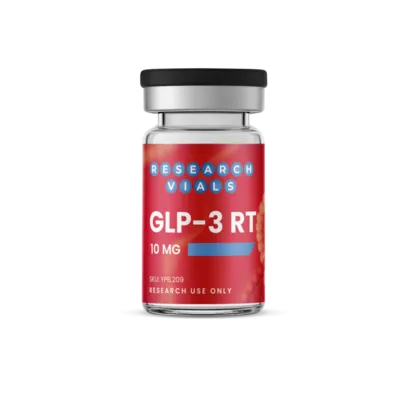
Research-grade GLP-3 RT is available from Research Vials at $71 per vial with third-party Certificate of Analysis (COA) verification. When sourcing this compound, researchers should verify peptide purity (>= 98% by HPLC), confirm molecular identity via mass spectrometry, and ensure proper cold-chain shipping to maintain lyophilized product integrity.
References
- Jastreboff AM, Kaplan LM, Frias JP, et al. Triple-hormone-receptor agonist retatrutide for obesity. N Engl J Med. 2023;389(6):514-526. PMID: 37351564
- Rosenstock J, Frias J, Jastreboff AM, et al. Retatrutide, a GIP, GLP-1 and glucagon receptor agonist, for people with type 2 diabetes. Lancet. 2023;402(10401):529-544. PMID: 37385280
- Jastreboff AM, Aronne LJ, Ahmad NN, et al. Tirzepatide once weekly for the treatment of obesity. N Engl J Med. 2022;387(3):205-216. PMID: 35658024
- Wilding JPH, Batterham RL, Calanna S, et al. Once-weekly semaglutide in adults with overweight or obesity. N Engl J Med. 2021;384(11):989-1002. PMID: 33567185
- Coskun T, Urva S, Roell WC, et al. LY3437943, a novel triple glucagon, GIP, and GLP-1 receptor agonist for glycemic control and weight loss. Cell Metab. 2022;34(9):1234-1247.e9.
Frequently Asked Questions
Research Use Only Disclaimer: All products referenced in this article are sold exclusively for laboratory research purposes. They are not intended for human or veterinary use, food additive use, drug use, or household use. This article is educational content based on published preclinical literature and does not constitute medical advice.