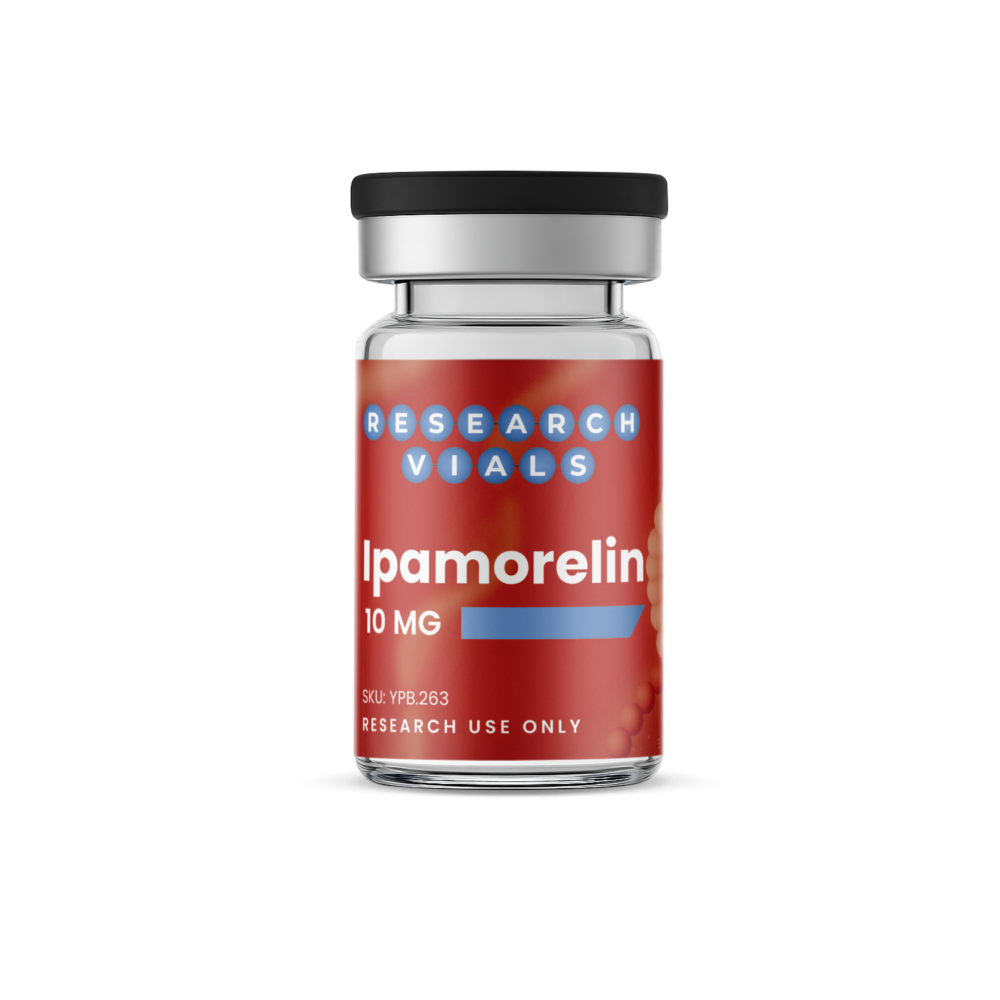
Ipamorelin stands out among growth hormone secretagogues for its remarkable selectivity. While older compounds like GHRP-6 and GHRP-2 stimulate GH release alongside unwanted increases in cortisol, prolactin, and appetite, Ipamorelin provides researchers with a cleaner pharmacological tool — activating the GH axis with minimal off-target hormonal effects.
What Is Ipamorelin?
Ipamorelin (Aib-His-D-2-Nal-D-Phe-Lys-NH₂) is a synthetic pentapeptide that acts as a potent agonist at the growth hormone secretagogue receptor (GHS-R1a), commonly known as the ghrelin receptor. Developed by Novo Nordisk, it was first described by Raun et al. in 1998 and has been studied in both preclinical and early clinical settings.
The compound's key research value lies in its selectivity: it stimulates growth hormone release from the anterior pituitary in a dose-dependent manner while producing minimal changes in ACTH, cortisol, prolactin, or FSH/LH levels — an unusually clean hormonal profile among GHS-R agonists (Raun et al., 1998; PMID: 9849822).
Mechanism of Action
Ipamorelin binds GHS-R1a on somatotroph cells in the anterior pituitary, triggering intracellular calcium mobilization and subsequent GH granule release. Unlike hexarelin and GHRP-6, Ipamorelin does not activate GHS-R at concentrations that would trigger ACTH release from corticotroph cells, explaining its cortisol-sparing profile.
The GH release pattern from Ipamorelin is pulsatile and physiological, mimicking natural GH secretion patterns more closely than exogenous GH administration. Peak GH levels occur approximately 30-40 minutes after administration, with return to baseline within 2-3 hours.
Why Selectivity Matters in Research
For researchers studying GH-dependent pathways in isolation, Ipamorelin's selectivity is its primary advantage. When using GHRP-6, observed effects could be attributed to GH, cortisol, prolactin, or appetite changes. With Ipamorelin, the cleaner hormonal profile allows more confident attribution of effects to the GH axis specifically.
Hansen et al. (2001) demonstrated in clinical studies that Ipamorelin at therapeutic doses produced no significant changes in cortisol or ACTH levels, even at high doses that maximally stimulated GH release. This selectivity window is substantially wider than that of any other peptide GH secretagogue studied to date (Hansen et al., 2001; PMID: 11713213).
Bone and Musculoskeletal Research
Ipamorelin has been studied in ovariectomized rat models (simulating post-menopausal bone loss) where it increased bone mineral density and improved markers of bone formation. The peptide also shows activity in muscle wasting models, consistent with GH's known anabolic effects on lean body mass.
Gastrointestinal Motility Research
An intriguing secondary application emerged when studies showed Ipamorelin could stimulate GI motility, likely via the ghrelin receptor's role in enteric nervous system signaling. This led to investigation in post-operative ileus models, where Ipamorelin accelerated return of bowel function — an application that progressed to clinical trials.
Research-Grade Ipamorelin
Ipamorelin is available in 10mg lyophilized vials at researchvials.com, with HPLC purity ≥99% and mass spectrometry verification.
References
- Raun K, et al. Ipamorelin, the first selective growth hormone secretagogue. Eur J Endocrinol. 1998;139(5):552-61. PMID: 9849822
- Hansen BS, et al. The effect of the GHS Ipamorelin on growth hormone release. J Clin Endocrinol Metab. 2001;86(3):1284-91. PMID: 11238522
Frequently Asked Questions
Research Use Only Disclaimer: All products referenced in this article are sold exclusively for laboratory research purposes. They are not intended for human or veterinary use, food additive use, drug use, or household use. This article is educational content based on published preclinical literature and does not constitute medical advice.